Back in its heyday, Nikon’s 5cm f/1.4 LTM lens was the rock star of the photography world, propelling Nikon into the big leagues and giving Leica aficionados a run for their money. Rumor has it, this lens even had war photographer David Douglas-Duncan swapping out his Leica lenses faster than you can say “cheese.” Yep, Duncan found these Japanese gems to be snappier and more contrasty, perfect for capturing the gritty drama of black and white news photography. Legend has it that even the editors at Life magazine mistook his shots for large format masterpieces.
The Unconventional Field Test
Now, strap on your combat helmet and lace up those boots, because I’m about to take you on a wild ride through Scarborough Beach and Hillarys Boat Harbour in Perth, Western Australia. Armed with my trusty Zorki 4k and loaded with Ilford HP5 ammo, I decided to put this old-timer through its paces. And let me tell you, it was a battlefield out there, with soccer mums jostling for their morning lattes and surf lifesaving helicopters buzzing overhead like something out of M*A*S*H.
A Closer Look at Performance and Character
But let’s cut the theatrics and get down to the nitty-gritty. This lens may be a vintage beauty, but how does it hold up in today’s pixel-peeping world? Well, let’s just say, it’s a bit of a mixed bag. Sure, it’s got that classic Sonnar design, giving off fuzzy vibes straight from a 70s soft-porn flick at wide apertures, but don’t let that fool you. This lens can still pack a punch, especially when you stop it down and give it some breathing room.
But hey, no lens is perfect, right? And this one’s no exception. From wonky rangefinder issues on my Zorki 4k to a scratch on the rear element, using this lens had its quirks. But even in my hands you see the magic it can create and I think that’s enough to forgive its imperfections.
So, is it worth the hype and the hefty price tag? Well, that’s for you to decide. But for me, this lens is more than just a piece of glass—it’s a ticket to a bygone era, a reminder of the glory days of photography. And hey, if it was good enough for war photographers dodging bullets, it’s good enough for me. So here’s to you, Nikon 5cm f/1.4, you may be old, but you’ve still got it where it counts.
One Yashica 635 Twin Lens Reflex Camera, One Roll of Kodak Gold 200 Film, and One Clumsy Photographer. The stage is set for a comedy of errors. Picture it: a sunny day, a camera in hand, and me, the clumsy protagonist, eager to capture the world through the lens of my trusty Yashica 635. Little did I know, a series of misadventures awaited.
Now, let me preface this tale by admitting my limited experience with this particular camera. While I’ve owned it for some time, our relationship has been more acquaintanceship than intimacy. And let me tell you, befriending a TLR (Twin Lens Reflex) camera is akin to navigating a labyrinth blindfolded. The handling is unlike anything I’ve encountered before—akin to trying to juggle flaming torches while riding a unicycle. If that sounds like an excuse, well, it probably is. But hey, let’s laugh at my foibles together, because trust me, if you haven’t wrestled with a TLR, you’re bound to stumble along the way too.
The journey begins innocently enough, the sun setting as I embark on my photographic escapade. Two shots down, and all seems well. But with the encroaching darkness, I failed to anticipate my utter ineptitude with this camera in low light conditions.
Armed with a tripod but sans tripod mount, I stumble through the dusk, it’s a scene straight out of a slapstick comedy—minus the laugh track. As I fumbled through the darkness I realised there’s a lesson to be learned amidst the chaos. Or at least that’s what I tell myself to salvage a shred of dignity from this debacle.
The Yashica 635
Now, let’s talk about the star of the show: the Yashica 635. Picture it as the middle child between the illustrious Rolleiflex and the humble Lubitel or Seagull. It may not boast the prestige of its elder siblings, but it holds its own in the quirky world of TLRs.
Dating back to 1958, this camera boasts a unique feature: the ability to shoot 35mm film with the help of an adapter—a rare gem for collectors, indeed. But beyond its novelty, the 635 operates like most TLRs, with its dual lenses and intricate mechanics.
Ah, but here’s where the fun begins—or rather, the frustration. You see, unlike modern SLRs with their handy prisms, TLRs present a topsy-turvy world. What you see through the viewfinder is but a mirror image of reality, leading to a dizzying dance of lefts and rights as I strive to frame the perfect shot.
But fear not, for science offers solace in the form of habituation. Yes, dear viewer, with time and practice, even the most topsy-turvy of worlds becomes familiar terrain. Just ask any psychology student who’s endured the “upside-down goggles” experiment—though I suspect their misadventures pale in comparison to mine.
Undeterred by my initial failures, I venture forth once more, this time bathed in the forgiving light of day. And lo and behold, progress! Though not without its hiccups, my second outing with the Yashica yields glimpses of its true character—quirks and all.
A Flawed but Beautiful Camera
Let’s not overlook its flaws. From film loading mishaps to the peril of double exposures, the 635 is not without its challenges. Yet, amidst the chaos lies beauty, because when it sings, medium format magic awaits, with its dreamy bokeh and timeless allure.
And let us not forget the charm of street photography with a TLR—unobtrusive, nostalgic, and occasionally mistaken for a relic of days gone by. For in a world of sleek digital wonders, there’s a certain romance to be found in the mechanical embrace of a Yashica.
But I digress. Let us return to the heart of the matter: the joy of failure. For in our missteps lie the seeds of growth, the kernels of wisdom waiting to be harvested. So here’s to the Yashica 635 and all who dare to dance with her—a flawed beauty in a world of perfection.
As Winston Churchill once said, “Success is not final, failure is not fatal, and it’s the courage to continue that counts.” So here’s to courage, to laughter, and to many more misadventures behind the lens.
Let’s embark on a journey into the heart of one of photography’s most captivating elements: light. Ah, yes, light—the ethereal essence that dances upon the canvas of our visual narratives, weaving tales of brilliance and shadow, of illumination and obscurity. But what truly defines this enigmatic force?
Allow me to shed some light on the matter—pun intended. We all know light is the radiant energy manifested in the form of electromagnetic radiation, with wavelengths spanning from 380 to 750 nanometers, perceptible to the human eye. However, let us not confine ourselves rigid constraints of scientific definition. Let’s delve into the realm of poetry, where light becomes glancing, gleaming, glimmering, and beyond – and that’s just the G words.
Light shifts and changes. While our friends in the northern hemisphere find themselves enveloped in the cloak of darkness, here in my corner of the world, we find ourselves basking in the relentless embrace of summer’s scorching sun, leaving the venerable Sunny 16 rule in faded tatters. Here it goes up to 22.
Light and the Nikon L35AD
The Nikon L35AD is a date-back edition of the esteemed Nikon L35AF. This camera deserves a full review but let us not be hasty; today, our focus lies solely on its ability to harness that most precious of commodities—light.
Don’t expect an objective and scientific treatment of the subject here, though. There’s nothing objective about film. Film imbues each frame with a unique character, a personality all its own. In the case of my chosen film, Kodak Ultramax, we have a medium contrast stock, suitable for a myriad of conditions. However, as the astute among you may have already discerned, there were… complications. Yes, complications stemming from my own hubris.
There might have been a few errors during the development process. The results were a bit underdeveloped resulting in thin negatives. But I don’t blame the Nikon L35AD here. There error was in the one factor I could control – me.
Direction, Intensity, Quality, and Continuity: A Quest for the Perfect Light
So let’s try to break this concept down. Light has direction, intensity, quality, and continuity. Direction is probably the most obvious. As a young photographer, I was often reminded to shoot with the light at our backs, bathing our subjects in a soft, even glow. But that simplicity belies the true complexity of light’s nuances. Shoot from the side, you get more dimensionality and with the light behind your subject you get all the fun of silhouettes and halos.
Intensity, too, plays a pivotal role in shaping our photography. From the blistering radiance of the Australian sun to the gentle caress of cloud-filtered light, each variation presents its own unique challenges and opportunities. But sheer intensity isn’t everything. Whether crisp and clear or soft and diffused, the quality of light infuses our images with a palpable sense of atmosphere.
Finally, continuity. This often overlooked dimension of light isn’t so much about the light itself as the scene. Shadows dance across the landscape, reflections shimmer upon the water’s surface, and every object becomes a player in the grand symphony of illumination. How things in the scene, reflect, block and break up the light is a key component of being able to play with it.
Embrace the Light: A Call to Arms
In the end, whatever conditions you find yourself in, cast aside the shackles of convention and venture forth into the boundless realm of photographic exploration and embrace light. Let’s revel in the myriad possibilities that light presents, bending it to our will, shaping it to suit our vision. In the end, it is not the rules that define us, but our willingness to challenge them—to forge our own path in pursuit of luminous enlightenment.
So go forth, and may the light illuminate your path as you capture the world’s wonders through the lens of your camera.
Ah, the allure of the Leica M6, a camera to flaunt wealth and artistic prowess alike. But why bother with ostentation when you can blend in with the proletariat using a humble companion like the Nikon N55? Sure, you won’t garner as many admiring glances, but the stares you do receive may be tinged with curiosity or bemusement, which, let’s face it, is attention nonetheless.
Let me regale you with the tale of my photographic escapades through the bustling streets of Shanghai, armed not with a Leica but with the unassuming Nikon N55 and a curious film stock mysteriously labeled as 800T, procured from the upscale online emporium that is Ali Express. With this unassuming combination in hand, I embarked on a journey to capture the essence of the city.
As I peered through the viewfinder of the N55, a sense of anticipation mingled with uncertainty. Something seemed amiss – the exposure appeared off-kilter, suggesting a potential mismatch between the film speed and the camera’s settings. Despite this initial hiccup, I resolved to soldier on, embracing the idiosyncrasies of the N55, which stubbornly refused to recognize DX codes, leaving me with no option but to compensate for the overexposure manually.
Undeterred by technical hiccups, I ventured forth into the labyrinthine streets of Shanghai’s historic neighborhoods, where brighter conditions finally afforded me the opportunity for more favorable shooting conditions. The results, while not without their flaws, offered glimpses of everyday life in this vibrant city – from the hustle and bustle of the marketplace to the quiet serenity of a secluded alleyway.
Now, let’s delve into the enigma that was the 800T film. Despite my initial reservations about its origins and processing, it performed admirably, even when subjected to a two-stop overexposure. A cautious approach to development paid dividends, yielding clean, balanced negatives that belied the film’s budget-friendly origins.
Yet, amidst the mundane scenes captured on film, a few moments stood out like diamonds in the rough – a fleeting glimpse of Chinese line dancing in a sunlit square, the mesmerizing interplay of light and shadow on the city’s architectural facades, and the endearing charm of canine companions frolicking in a local park. These ephemeral encounters served as poignant reminders of the richness of life, transcending mere visual aesthetics.
The Nikon N55 and 28-80mm f/3.3-5.6G
But what of the N55 itself? Despite its plastic construction and finicky autofocus, it proved to be a stalwart travel companion, compact enough to slip into carry-on luggage yet robust enough to withstand the rigors of urban exploration. Its quirks and limitations only added to its charm, serving as a testament to the resilience of analog photography in an increasingly digital age.
A new roll of film, this time some Kodak Colorplus 200 and while it didn’t give me those same classic Cinestill halations or cinematic tones, it was more than able to capture the veracity of the streets with its muted palate.
And let us not overlook the unsung hero of this photographic odyssey – the 28-80mm kit lens. Despite its modest specifications, it delivered surprisingly sharp and contrasty images, a testament to the craftsmanship of its optics. In the hands of a skilled photographer, it transformed mundane scenes into captivating vignettes, elevating the humble N55 to new heights of artistic expression.
Great for Travel
In the end, the Nikon N55 may not have the cachet of a Leica or the technical prowess of a modern DSLR, but it more than held its own in capturing the essence of Shanghai’s bustling streets. It’s small and light so it won’t break your back on a long day of shooting. It’s cheap and even cheaper looking so no-one is going to mug you for it. Its kit lens is surprisingly sharp and it’s quick, smooth, and responsive. So, if you find yourself in need of a reliable travel companion, look no further than this unassuming gem of a camera – the Nikon N55.
Today, I’m embarking on a journey into the world of vintage cameras with the Nikon N2020, dating back to 1986. The burning question on my mind: Is it as sharp as its name suggests, or does it fall into the category of outdated relics like acid wash jeans and hypercolour t-shirts? Join me as I set out to uncover the truth about this iconic piece of photography history.
Stepping back into the vibrant decade of the 1980s, I can’t help but feel a sense of nostalgia wash over me. But beyond the retro vibes, the Nikon N2020, also known as the Nikon F-501 in some parts of the world, captures the essence of its era with its sleek design and futuristic name. It’s like a time capsule, transporting us back to a period when the future seemed dazzlingly bright, and everyone rocked sunglasses at night.
Released in 1986, the Nikon N2020 emerged amidst a musical landscape dominated by hits like Duran Duran’s “Girl’s on Film” and J Geils Band’s “Freeze Frame”. It’s a time when every song seemed to begin with the sound of a motorized film winder, evoking a sense of nostalgia for a bygone era. The camera itself continues the sleek aesthetic of its predecessors, maintaining the iconic black exterior with red highlights that epitomized the 80s. It’s a nod to an era characterized by bold fashion choices and vibrant color palettes.
Despite being crafted from polycarbonate rather than brass, the Nikon N2020 feels surprisingly solid in my hands. Weighing in at 604g, it’s a testament to the durability of 80s design. Paired with a Nikon 28-105mm lens, the camera exudes an air of sophistication, blending seamlessly with the black plastic body. But beyond its aesthetic appeal, the lens proves to be a reliable companion, delivering sharp images throughout the zoom range with minimal distortion and chromatic aberration.
As I embark on a Sunday walk at my local beach to put the Nikon N2020 to the test, I encounter a minor hiccup with the film. However, this setback is quickly resolved with a second roll, allowing me to fully immerse myself in the shooting experience. Despite occasional struggles in bright light and the absence of a shutter priority mode, the camera impresses with its fast shutter speed and versatile shooting modes.
But let’s not overlook the quirks and flaws of the Nikon N2020. Its ergonomic design leaves much to be desired, and the motor drive isn’t exactly discreet, announcing its presence with a noticeable whir. Autofocus can be hit or miss, occasionally settling just forward or backward from the selected focus point. However, the bright viewfinder and LED focusing aid help mitigate these issues, ensuring a relatively smooth shooting experience.
Despite its imperfections, the Nikon N2020 boasts some impressive features for its time. From autofocus modes to TTL metering, it offers a level of control that’s commendable for a camera of its era. And with the ability to use both manual and DX settings for ISO, it provides flexibility in various shooting conditions.
As I reflect on my experience with the Nikon N2020, I can’t help but appreciate its timeless appeal. While it may not be perfect, it captures the essence of the 1980s in all its glory. And much like the era it represents, it’s a reminder that perfection is elusive, but beauty lies in imperfection. So, while I may not be flawless myself, I can embrace the retro charm of the Nikon N2020 and moonwalk through life with confidence. After all, in a world where nothing is perfect, sometimes it’s the quirks that make us truly memorable.
Let’s dive right in, shall we? We’re talking about a particular gem in the realm of camera lenses: the Nikon 50mm f/1.2 AI-S. Now, this isn’t just any 50mm lens; it’s a certified light bucket. Back in 1978, when it first hit the scene, it promised to suck in light like a black hole without leaving your photos in a pit of despair. But does it still hold up in today’s unforgiving photographic landscape?
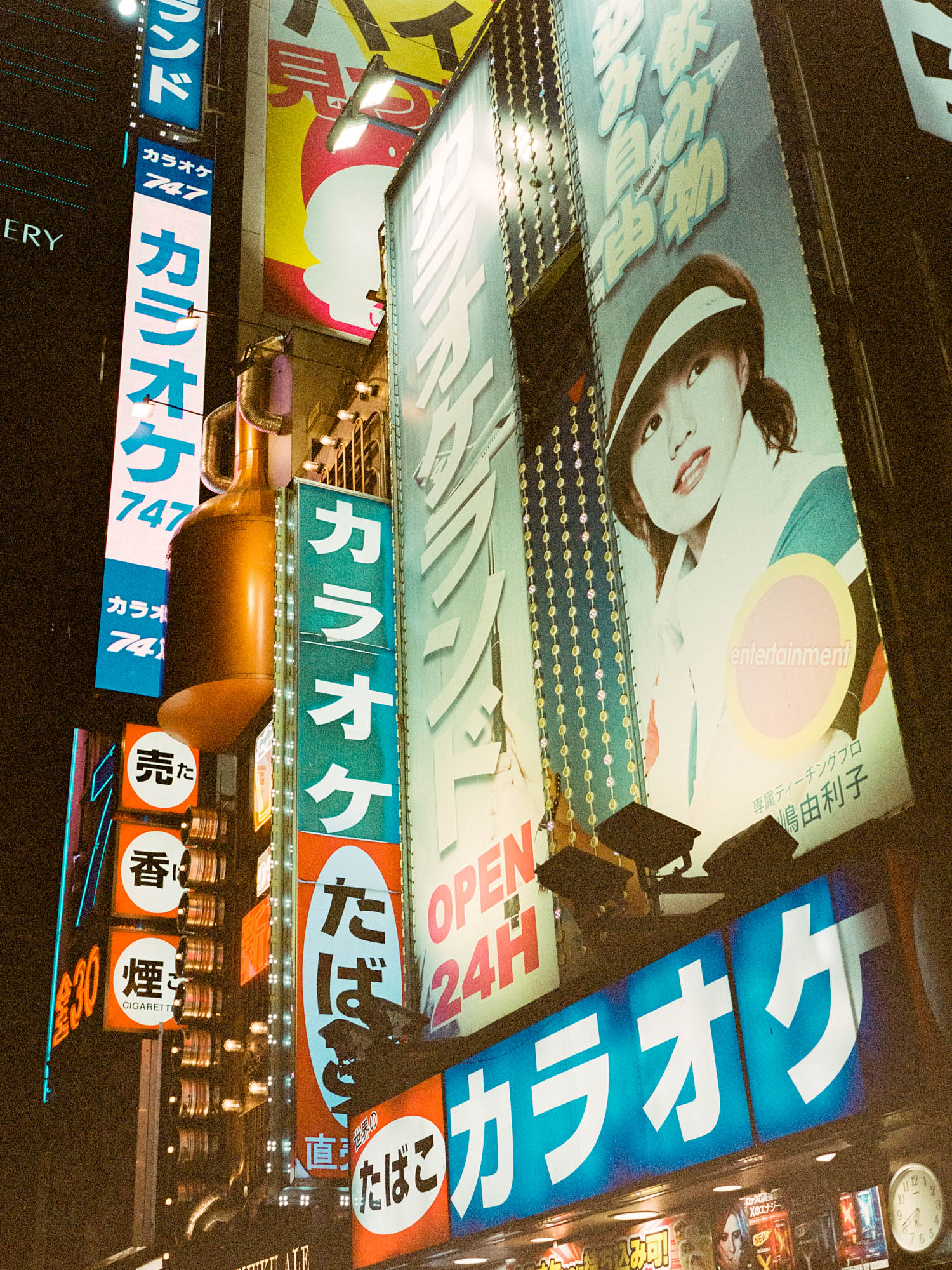
As the neon lights of Tokyo’s Shinjuku district flickered to life, I found myself armed with my trusty Nikon FE paired with the venerable Nikon 50mm f/1.2 AI-S lens. Venturing into the bustling streets, I was eager for a night off from my teaching responsibilities, ready to immerse myself in the vibrant energy of the city. I found camaraderie in the unlikeliest of places, forging bonds with newfound friends who shared a passion for exploration and discourse. As the night unfolded, I couldn’t help but marvel at the serendipitous moments captured through the lens of my Nikon FE, each frame a testament to the spontaneity and vibrancy of Shinjuku’s streets.
A Dance with Film and Light
Despite the film’s lack of objective reference for white balance, I embarked on a journey of post-processing exploration, extracting the raw beauty of the night through the lens of Lightroom. Amidst the chaos of the city, the Nikon 50mm f/1.2 AI-S lens stood as a stalwart companion, capturing moments with its timeless design and solid construction.
As I scanned the negatives, I marveled at the smorgasbord of colors and textures captured by the lens. From the vibrant hues of neon signs to the subtle interplay of light and shadow, each image told a story of urban life illuminated by the glow of the night. While some may dismiss the imperfections of the film as shortcomings, I embraced them as part of the charm, adding depth and character to my photographic narrative.
Nikon 50mm on Generic 800T Motion Picture Film
A Lens with Character
The Nikon 50mm f/1.2 AI-S lens boasts a rich history spanning over four decades, embodying a blend of craftsmanship and character. Despite its imperfections, this lens possesses a unique charm that transcends technical limitations. Its wide aperture renders scenes with a delicate balance of sharpness and softness, akin to an artistic brushstroke painting the canvas of the night. However, its quirks, from vignetting to chromatic aberration, add to its allure, transforming mundane scenes into ethereal compositions.
Delving deeper into the lens’s optical design, I discovered its simplicity belied its complexity. With seven optical elements arranged in six groups, the lens exhibited a traditional spherical design that harkened back to a bygone era of photography. Yet, its longevity and durability spoke to its enduring appeal, standing the test of time amidst advancements in technology. While modern lenses may boast technical superiority, the Nikon 50mm f/1.2 AI-S lens remained a timeless icon, revered by photographers for its distinctive character and versatility.
The Next Day, Shot with Ilford HP5 Pushed to 1600 ISO
Testament to a Legend
While modern optics may boast technical superiority, the Nikon 50mm f/1.2 AI-S lens stands as a testament to craftsmanship and individuality. Its imperfections become its strengths, offering photographers a tool to craft images imbued with personality and depth. From the glow of neon lights to the subtleties of the night, this lens embraces the art of photography, inviting exploration and creativity. As the world moves towards newer technologies, this lens remains a beacon of tradition and innovation, challenging photographers to see beyond perfection and embrace the beauty of imperfection.
In conclusion, Nikon’s 50mm f/1.2 AI-S lens may not be a flawless masterpiece, but it is undeniably an icon of photographic history. Its burnished brass and glass tell a story of craftsmanship and character, inviting photographers to embrace the quirks of analog photography in a digital age. So, as I reflect on my journey through the streets of Shinjuku, I can’t help but appreciate the timeless allure of this legendary lens, knowing that its legacy will continue to inspire photographers for generations to come.
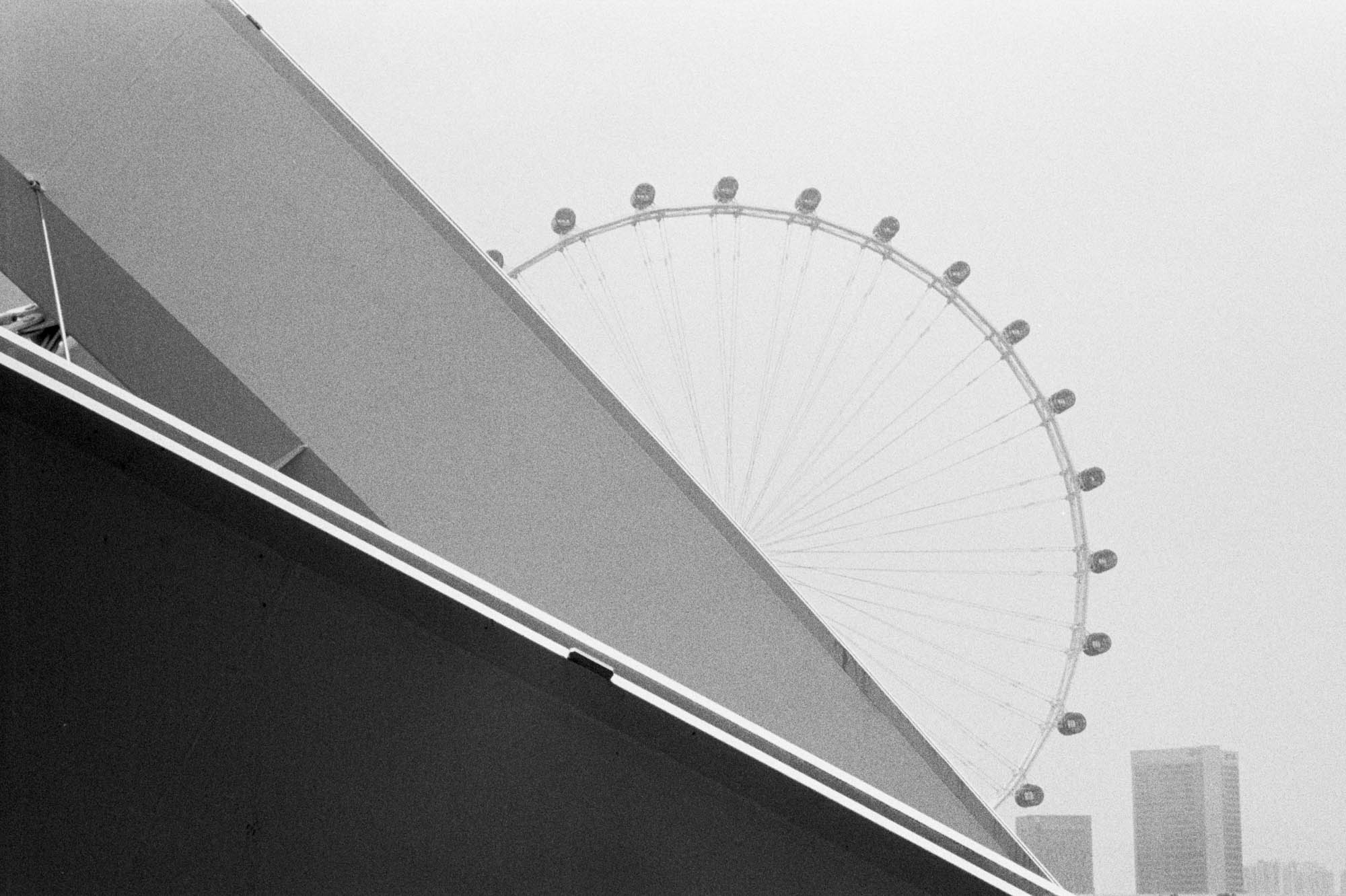
Welcome to he Pentax 120SW – a tiny do-everything-for-you point-and-shoot from right at the time where everyone started buying digital cameras. To test this camera out, I decided to explore the Gardens by the Bay area of Singapore to see if I could experience the wonder of nature.
The Wonder of Nature
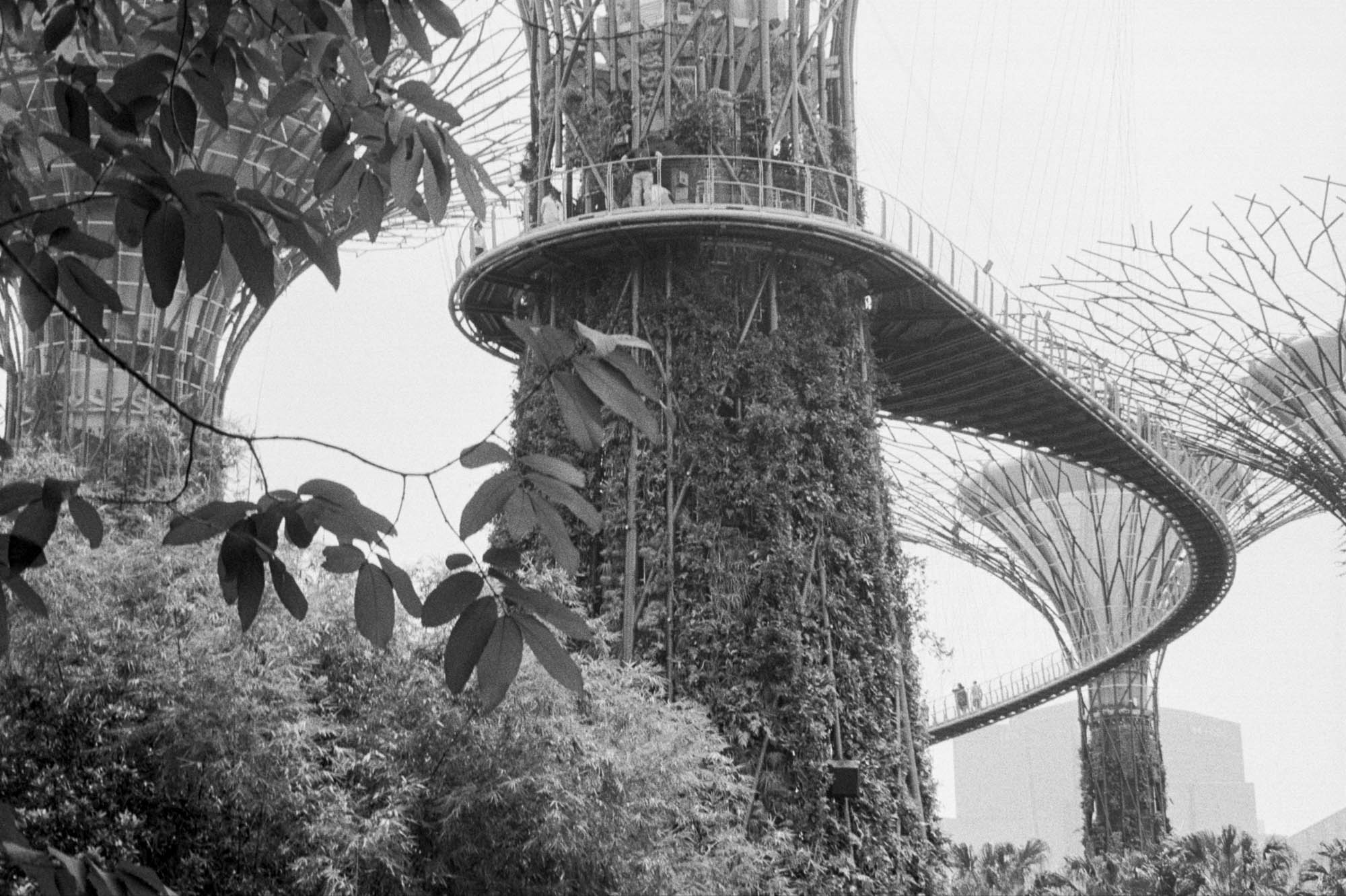
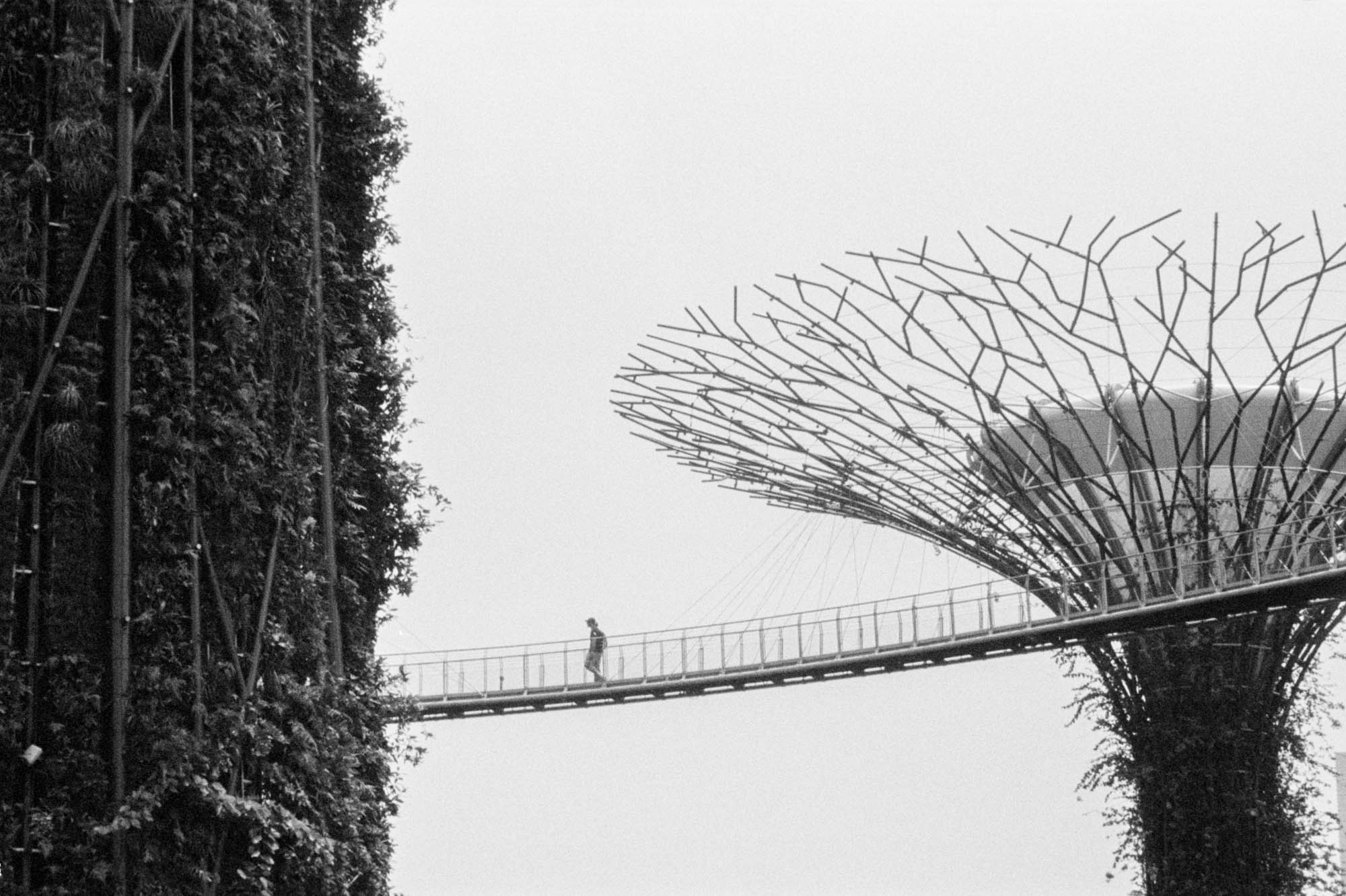
I think you can probably guess that the byline of the above video is somewhat sarcastic. Gardens by the Bay is as natural as a terra-formed Mars colony, with microclimate pods nestled among metal trees, all in the shadow of Marina Bay Sands hotel.
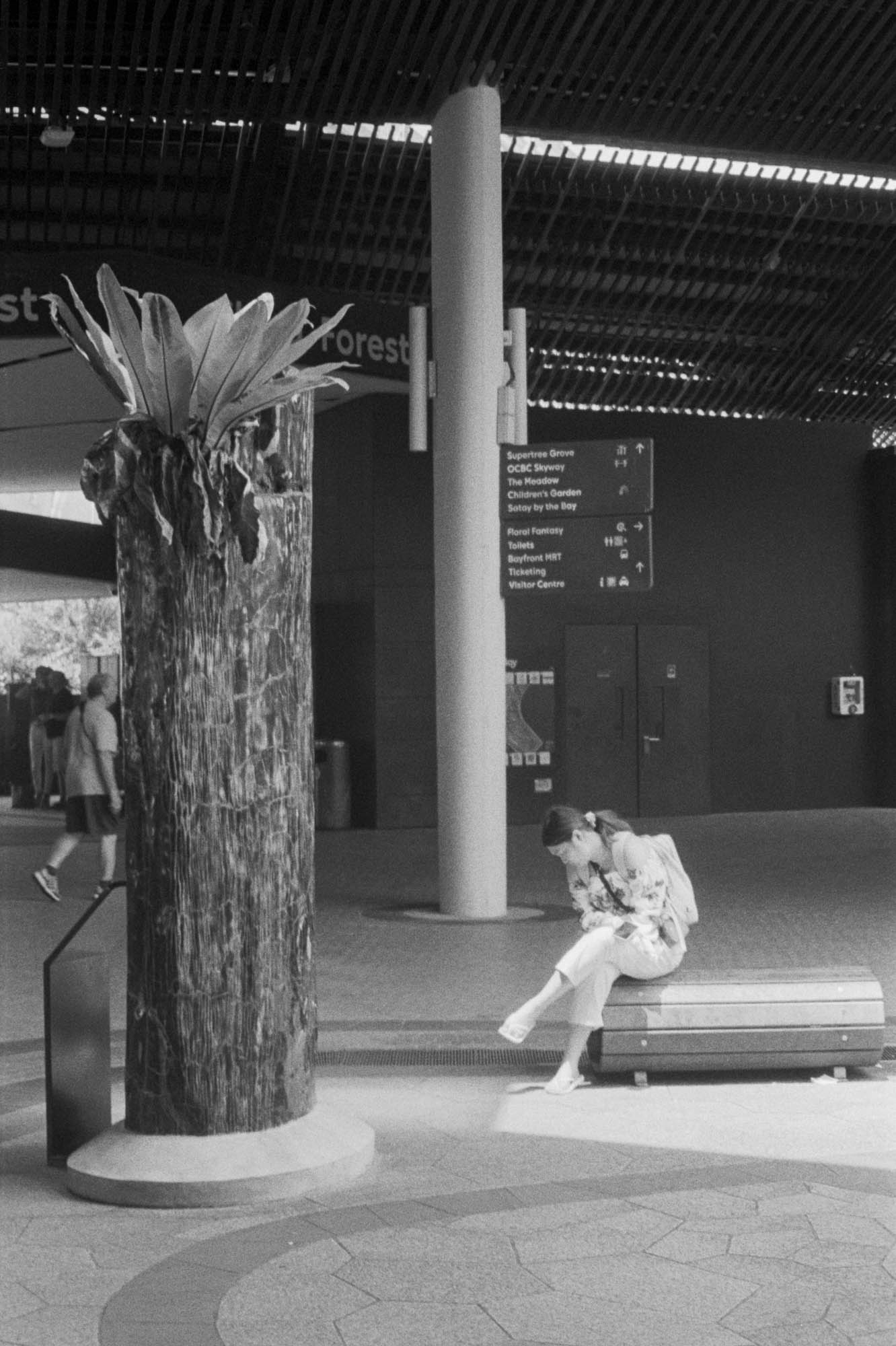
Most of the nature exploration involved photographing the topography and the tourists that milled around the area – wildlife of sorts, I suppose, just not the normal fodder for a David Attenborough documentary.
Using a mix of Ilford HP5 and Kodak Colorplus 200, I nevertheless put on my virtual pith helmet, strapped on my scythe and cut a swathe through the metal and concrete forests of Gardens by the Bay.
About the Pentax Espio 120SW
Well what’s to say? It’s a point and shoot.
It has a 28-120mm F5.6-12.8 lens, 6 elements in 5 groups, autofocus with focus lock, and with a minimum focus of 0.5m. It’s shutter speeds are from 2-1/360s and it has a bulb mode that’s 1/2s-1min though if it came with a remote shutter, I don’t have one so I’m not sure how useful bulb really is.
Like many point-and-shoots, this one is small and it’s light. It weighs 190 gr. without battery.
Pentax Espio 120SW
That, and it’s sweet sexy looks ,are probably it’s main attractions. Apparently, other than the film door it has an aluminium body. I don’t know though. It tastes like plastic to me. I don’t know how much this cost either but it was definitely positioned at the ‘luxury’ end of Pentax’s plastic point and shoot lineup.
in 2001 it won the Technical Image Press Association’s compact camera of the year award. But given those times, it’s probably like winning ‘Best new DSLR’ in 2023 when the whole world has gone mirrorless. You do get a really pretty orange backlight on the LCD though.
One of the problems is that it’s a Pentax. This was a company that churned out compact camera models like barbecue sausages and it’s not like there was ever much cachet in owning one. I have several Pentax point-and-shoots in my cupboard. I also have a few broken ones now hidden in draws that I might sell on ebay some time labelled ‘top mint’ but with ‘please read’ asterisked and in small print.
The fact is that there were so many camera versions, some good, some bad. How do you know if you’ve got a decent one?
Well you may have already made up your mind on this one but I think to make an accurate judgement, it’s only fair that I use some of that money I’ve been saving up for my kids education and blow it on a roll of colour film. Seriously, the things I do for science. And nature … obviously. Now this was Kodak Ultramax. Still a fast film at ISO400 but still a challenge for such a small aperture zoom on a cloudy day. BUT if Livingstone could conquer Everest with nothing but a woolly bobble hat and a block of Kendal mint cake then I could take on the challenge of Marina Bay with my trusty Pentax. Actually I might have got some of that detail wrong but that’s what happens when you trust Chat GPT to write your reviews for you.
A Slow-Lensed Camera
The Pentax Espio 120SW is perhaps not the best camera out there in terms of specifications and it doesn’t have a full array of modes and features. There’s no portrait, sport mode or dedicated macro facility here. You really have very little control.
You do get 25-3200 ISO, automatic DX coding, self-timer, automatic film advance, infinity and spot AF modes.
And for what it is, it’s capable of producing great results. It can meet the resolution of film and my favourite photos show that this has a lens that can be both sharp and contrasty. I didn’t really see much flare either thanks to it’s ‘super multi coating’.
If you use it properly it delivers good results. Unfortunately I bet back in the day there are a lot of people who have used this camera and wondered why the images came out blurry. That probably comes down to the lens. It has a maximum aperture of f/5.6 at 28mm down to f/12.8 at 120mm. That makes it tighter than the proverbial cat’s anus, though I haven’t actually done that test myself and I don’t know any proverbial feline proctologists.
You only get a focus confirmation or a warning light to tell you to use flash in the viewfinder and that’s not much feedback. It’s definitely capable at 120mm as shown here but where my shots failed it was usually because I was being overly optimistic of my ability to hand hold. Even with 400ISO, a dull day in Singapore meant that telephoto and slow shutter speeds conspired to give me soft results. Don’t bother putting 100 speed film in this unless you’re prepared to shoot with the flash turned on.
But it’s Sharp
On a sunny day like we have here in Australia I still managed to get great results. Finishing the colour roll, I was able to get really vivid photos like this.
Admittedly, I might have underdeveloped a bit, which often gives colours, contrast and grain a bit of a boost but if you look here, you can see that it produces pleasing images.
As with any example of this kind of camera, though, you have to accept a certain randomness in the results it produces. There was no way I could tell the camera where to focus in this photo and while having the ability to at least spot focus fix on infinity focus is nice, the end results can be a bit unpredictable depending on the film or quality of light. I wasn’t really able to get it to produce any bokeh but that’s hardly surprising. I could get some subject separation if I shot close up and what I did see in the out of focus areas wasn’t ugly. It just wasn’t particularly distinctive.
So what’s your experience with cameras like this? Have you owned this particular model and what do you think of it? Some point and shoots can be ridiculously overpriced these days. I’m looking at you Olympus Mju II.
If you’re prepared to slum it at the ugly end of the Pentax range, though, you might find a bargain. There are definitely hidden gems out there if you are prepared to be patient.
But let me know your thoughts. From my perspective, if not the best tool for the job, this camera isn’t the worst. And like your phone it’ll give you a photographic experience that you can put in your pocket; just with this one, it’s actual film.
My advice, though, use a FAST film so you can make the most of the sharpness of the lens stopped down and give you a bit ore leeway with hand holding. Or use flash, which on these things is… ‘a look’ and who knows? Maybe one I’ll experiment with a bit more on a future review.
The word perkeo means pygmy and while probably neither of these terms are very politically correct, those were different times and I don’t think the pygmy hippopotamus is going to sue my YouTUBE channel for being sizist.
Still, it’s small, it’s cute, it unfolds and in that sense it’s a delight. This particular camera had been gathering dust for a while before being gifted to me by someone who’d been following my photography. I’ve had this for around six years now and I have used it well.
Most recently I found myself in Singapore for work and I had the option of either settling into another round of tiger beer with colleagues or taking the Perkeo with me for a brief walk from Bugis to Little India. I had two rolls of Ilford HP5 pushed to ISO 1600 and a fierce determination to find interesting subjects and pockets of light to illuminate them.
One of the cool things about Singapore is the different styles and cultures you can find in such a small area. It was just a short train ride from Promenade to Bugis Junction, where the stark modernity of Marina Bay gave way to a much more human and slightly chaotic street culture.
About the Camera
So what about the Voigtlander Perkeo 1? As the name suggests, this was the first version of the camera – it was superseded by the Perkeo 2 and the Perkeo E. There were over 100,000 copies of the Perkeo 1 made and there were a few iterations. This particular version came with some tweaks to the original, such as the ability to close off the red frame advance window and a clever automatic locking mechanism to prevent double exposure.
So far that’s two rounds to Voigtlander against my human error but unfortunately it’s not a foolproof camera. It’s fiddly. Firstly, this is manual medium format camera. No surprises there. It dates back to the early 1950s when 120 film was the dominant format. So, larger roll film that can be a bit annoying to load in and out but you do end up with those gorgeous 6×6 square medium format negatives.
Capturing images on that film, though, can be a bit challenging. Most of the cool stuff sits on the lens. That’s because it has a leaf shutter built into it rather than a cloth or metal mechanism at the focal plane. The good side of that is that you have everything available right there and the flash can synchronise at every shutter speed. The bad side is that you find yourself having to make micro-adjustments with your fingernails for the shutter speed and aperture.
The shutter speed ranges from 1/250th to 1/25th of a second, or not very fast to not very slow, though it does have a bulb mode that you can use if you want to put it on a tripod. The aperture range goes from a not too small f/16 to a not very wide f/4.5.
I wouldn’t worry about the lack of wide aperture. One of the quirks of medium format is that because of the physical image size, for a given focal length you end up a with a commensurately narrower depth of field. That’s not just true of film. The sensor of your full-frame 35mm camera allows you to obtain that creamy bokeh in ways that your iPhone just can’t because of the miniscule chip inside it. Trust me, it’s all about physics. That or phases of the moon working on the tides, which in turn are making a butterfly in China flap its wings.
In any case, f/1.8 would be impractical here. If it opened up wider than around f/3.5 then the focal plane would be perilously thin. And that’s made worse because you have no focusing aids in the camera. You have to rely on your ability to judge distance … in feet since this is basically a relic of the imperial system.
For a camera like this, f/4.5 is probably about as wide as you can go while still being able to make sure your point of focus will be sharp. So don’t worry about the lack of wide aperture.
And I do say that but of course I was shooting at night. And I soon found out that the further away from Bugis I got, the deader and darker the streets became. Fortunately I’m a brave boy and armed with another roll of Ilford HP5, I tried to squeeze a final few frames before heading home.
What about the Results?
As you can probably guess from those photos, while I made my way to the Little India MRT, the opportunities thinned out just as the people did.
Overall I didn’t come away with lots of portfolio shots. I think the better shots were the ones that had people in them. I did hang around a couple of locations for people to walk by and in some cases, that took a long time.
And I’m not very patient. So apologies that instead of a fascinating street character, you end up with some random dude carrying a plastic shopping bag. Though I did find the poses of the people inside the building intriguing, if a little baffling.
But none of these photos are going to get me into Magnum. It was possibly a combination of the weeknight evening and my desperation to cram some creativity into a busy work schedule that’s to blame. And while shooting film at night with a nearly 70 year old camera was always going to be a challenge, I can’t really blame the technology.
Why I love the Voigtlander Perkeo.
In decent light, the Perkeo didn’t let me down at all. It’s sharp where it needs to be but still gives a nice characterful low contrast look that mitigates some of the issues of shooting ISO 1600. The fact that it’s medium format means the grain isn’t so noticeable and of course you do get that 3d pop when you shoot something fairly close wide open.
It has travelled the world with me, from Vancouver to Dubai, Estonia to Hangzhou. In fact I dropped it on the ground in Amsterdam once, leaving lovely big dent in the lens cover. Seriously, I don’t deserve good things.
It’s small but substantial, weighing in at 525g and if you’re patient enough to use an external meter and are comfortable with the square format, it takes some great shots. Even if you’re like me and too lazy to use a tripod or meter for exposure you can get good pictures from it – you just have to accept that not every photo is going to be a keeper.
So have you used one of these? If not, then it’s definitely worth seeking one out. I have a couple of other folding cameras – an Agfa Isolette and an even older Voigtlander Bessa that produces amazing 6×9 negatives, but this is probably the sweet spot in terms of size, quality and yes, even ease of use.
Perhaps not the greatest low light camera in the world but a gem nonetheless.
It was late February (not the 30th) and I was in Tokyo and wanted to go out and take some street photos on film. The classic choice of lens for this kind of photography would be something small and moderately wide. Maybe jump on the Diane Ar Bus with a 35mm or the get my Cartier Bress on with a slightly narrower 50mm.
But I didn’t do that. Instead I picked a monstrous old manual metal and glass 35-200mm zoom lens. Today we’re going to explore why.
A Marvelous Lens…
Was it the logical choice for the street? Probably not. But why do I find myself using this more than just about any other manual focus lens I own? It’s an optical marvel.
Before you spit vehemently on the floor at the description of a manual superzoom lens as a marvel, you have to cast your mind back to those bleak days of the early 80s when the optical imaging world was disrupted by the introduction of zoom lenses. It was a tumultuous time for lens manufacturing. Autofocus was starting to get its clumsy foot in the door and zooms were becoming more commonplace. After all, who doesn’t want a lens that gives you great versatility and ease of use?
In 1982 the longest zoom that Nikon could offer was a 50-135mm f/3.5. In the subsequent years, this range extended to 35-105 and 35-135mm. So you could see how they were incrementally improving things over time.
This particular lens was released in 1985 after what was by all accounts a long and tortuous process to design and refine it to achieve its 5.7x zoom range. That was the same year that Nikon released its first retail autofocus SLR the Nikon F-501. While the Nikon L35AF in 1983 had shown the potential of autofocus in compact cameras, it wasn’t mainstream at that point and the 501 was released at the same time as the manual focus F-301 which was probably more popular.
No autofocus but a very large zoom range. And In that context, when this lens was released, it was probably already a little out of date, while still being overly ambitious at the same time.
… But a Compromise
The result is a compromise but isn’t everything in life a compromise? You’re always going to struggle fitting your baby bassinet in your Bugatti Veron and if you’ve ever actually owned a pocketknife you’ll understand the limits of your corkscrew and scissors. Of course, that tool for getting the stones out of horse’s hooves is 100% fit for purpose even if that’s a purpose you’ll never need.
While the zoom range is great, it doesn’t go wider than 35mm.
The maximum aperture is 3.5 at the wide end and it’s variable to 4.5 at the long end. So not the worst but it’s not very fast.
It CAN focus as close as 0.27m or 0.86ft, giving a decent if not quite macro 1:4 life size reproduction. Annoyingly, that’s only at the 35mm end, accessible by a ring that increases the distance from the focal plane. Effectively a built in extension tube. It would be nice to have had it at the longer end to give you more working distance.
It does have amazing build quality. Really amazing. You could bludgeon your baby with it and given you might need to, to actually squeeze him into your Bugatti, that’s a selling point in itself. In any case, if you dropped it on your toes you’d be much more worried about your toes than the lens.
It weighs 740g or 1.63lbs for you imperials and that’s heavy but it is surprisingly compact. It has a 62mm filter thread which is actually quite small and probably smaller than most modern superzooms.
Compare it to Nikon’s modern 24-200mm Z lens and it still holds its own when you think that it’s nearly 40 years later. Well ok, it might teeter a bit.
While it is reasonably balances on my Nikon FE it’s not exactly discreet. The push-pull zoom itself is a compromise. I do have a couple of these style lenses and once you’ve had practice, it’s actually possible to zoom and focus in one action but this lens is bigger and much stiffer and more clumsy.
But it is what it is and I guess that’s going to be the theme of this review. But if it is what it is, then what is it? With all these compromises, is it good enough? To find out, I took the camera on a walk from Harajuku to Shibuya on a cold February day in Tokyo
From Harajuku…
It Is What It Is
Is this the swiss army knife of lenses or am I expecting too much? You can’t open a bottle of wine with it OR get the stones out of horses’ hooves. But can you take good pictures?
Earlier, I called this an optical marvel. There is a lot of lens crammed in here. Realistically, the marvel is that they managed to create it and it not be totally horrible. With 17 elements in 13 groups all working together to minimise aberration and field curvature at the various zoom lengths, it should have the light transmission qualities of a lump of coal.
But somehow light manages to reach the film plane and while this isn’t a 50mm f/1.2 Z lens, that lens can’t shoot 35 mm or 85mm or 135mm or 200mm. You get the idea.
It does distort but that’s very fixable and I have and no problems bending those lines back to right angles in post. F/3.5 is slow but you could see, on a winter’s day, it was still quite usable with 200 ISO Kodak Colorplus. The corners are soft wide open and diffraction creeps in by f/11 but at it’s rare that I’m going to want to shoot f/22 anyway.
I call it a Marvel and if there’s a downside to that, using it is the creative equivalent of watching a Marvel movie. You get a bit of comedy, romance, fantasy and action, and that’s even before I’ve taken the photo, just with trying to compose, zoom and focus with it is a drama. It’s not a shoot from the hip Arthouse experience though you could probably push a roll of HP5 in there if you want that black and white Zac Snyder aesthetic.
Perhaps my biggest complaint is that it is a bit like Captain Marvel. Overpowered but leaden and dull as a result, and I guess it ends up being a bit unsatisfying because it never quite lives up to its own ambition.
… to Shibuya
You can see that the best photos are the ones where I’ve had time to think through a composition to take in a street scene, capture close-up detail, or narrow the frame to point out details or find angles in the architecture. The strength of this lens is it’s versatility not it’s sharpness.
Great for the Price
In doing some research on this lens from people who actually know what they’re talking about, I found Nikon’s own review in which the words ‘relatively’ and ‘satisfactory’ both appear 6 times. That probably tells you something; and that’s coming from Nikon’s own PR machine.
It was never Nikon’s most successful lens but that might be because this hefty lens came with a hefty price-tag. As of 1996 this was still selling for US$1,290 and while it’s long discontinued now, that’s a testament to the engineering that went into it and the fact that there weren’t any great alternatives. As early as 1983 Tamron did have a 35-210mm lens available but from everything I’ve read, if that one’s a Marvel, it’s much more Carol Danvers than Nick Fury. For 15% of the original asking price you can now pick up an excellent quality copy and leave it on your camera. So why even bother to slum it in the 3rd party ghetto.
Ultimately, I’ve never heard anyone complain about the image quality. People don’t look at my photos and say, ‘oh, did you use a Nikon AI Zoom Nikkor 35-200mm f/3.5-4.5S’. They might say, ‘did you really take a photo of that.’ But that one’s on me, not the lens.
To me it’s sharp enough and when I look through my Lightroom catalogue it’s probably my most used lens. The reason for that may well be because I lack any sense of aesthetic intent as a photographer. I’m not getting up before sunrise to capture that perfect 20mm landscape, or using it exclusively for shallow depth of field portraits or sports photography.
This is the lens that I put on when I’m indecisive or feeling lazy. It’s a great travel lens and it’s also the one that I’ll stick on my camera when I’m just out walking the dog or don’t have any sense of what photographic opportunities might be out there. For me, that’s most of the time.
But let me know your thoughts. What’s your most versatile lens? Would you use a bloated beast like this or do you prefer to just take a wide prime locked to f/8 and zone focusing to capture the decisive moment?
The Fuji GA645Zi is my favourite and least liked camera. I call him Harvey after Harvey Weinstein. Big, ugly and powerful, promising you the world but more likely to leave you traumatised with your creative ambitions in tatters. This article will explain why.
You have to hand it to Fujifilm for bucking trends. Throughout the last decades of the film era, while Canon and Nikon were squeezing the last juice out of the 35mm SLR industry, companies like Fuji and Mamiya knew that the value of film lay in the quality and dynamic range of the medium and continued to innovate with larger format offerings that gave great quality while minimising the size. These days everyone lusts after the Mamiya 7 series of medium format rangefinders and this little device is a little neglected but in the 90s Fujifilm had a complete range of medium format cameras.
It’s 90s pedigree is unmistakable. Think boy bands, roller blading and the Rachel haircut. The same design sensibility carries through with its ‘champagne’ coloured plastic. You saw it on your Dad’s Honda Accord and you see it here… sleek and spangly, promising opulance like a knock off burberry handbag.
In the end, this is never going to win a camera beauty contest in the same way that a sumo wrestler isn’t going to be crowned Miss Universe. Its size alone makes this look gauche and clumsy. But as I keep protesting, looks aren’t everything. How does it perform?
Roll One
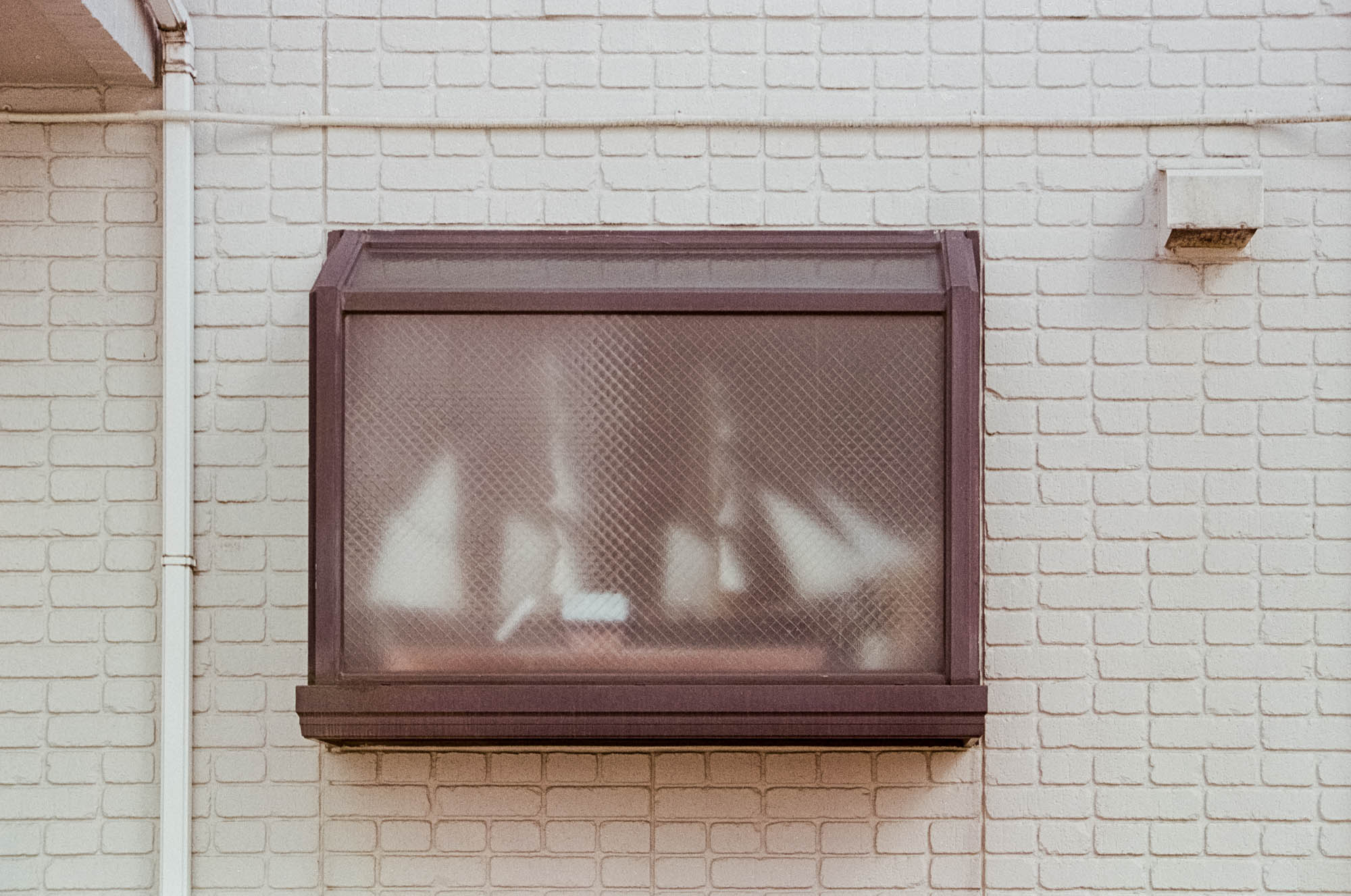
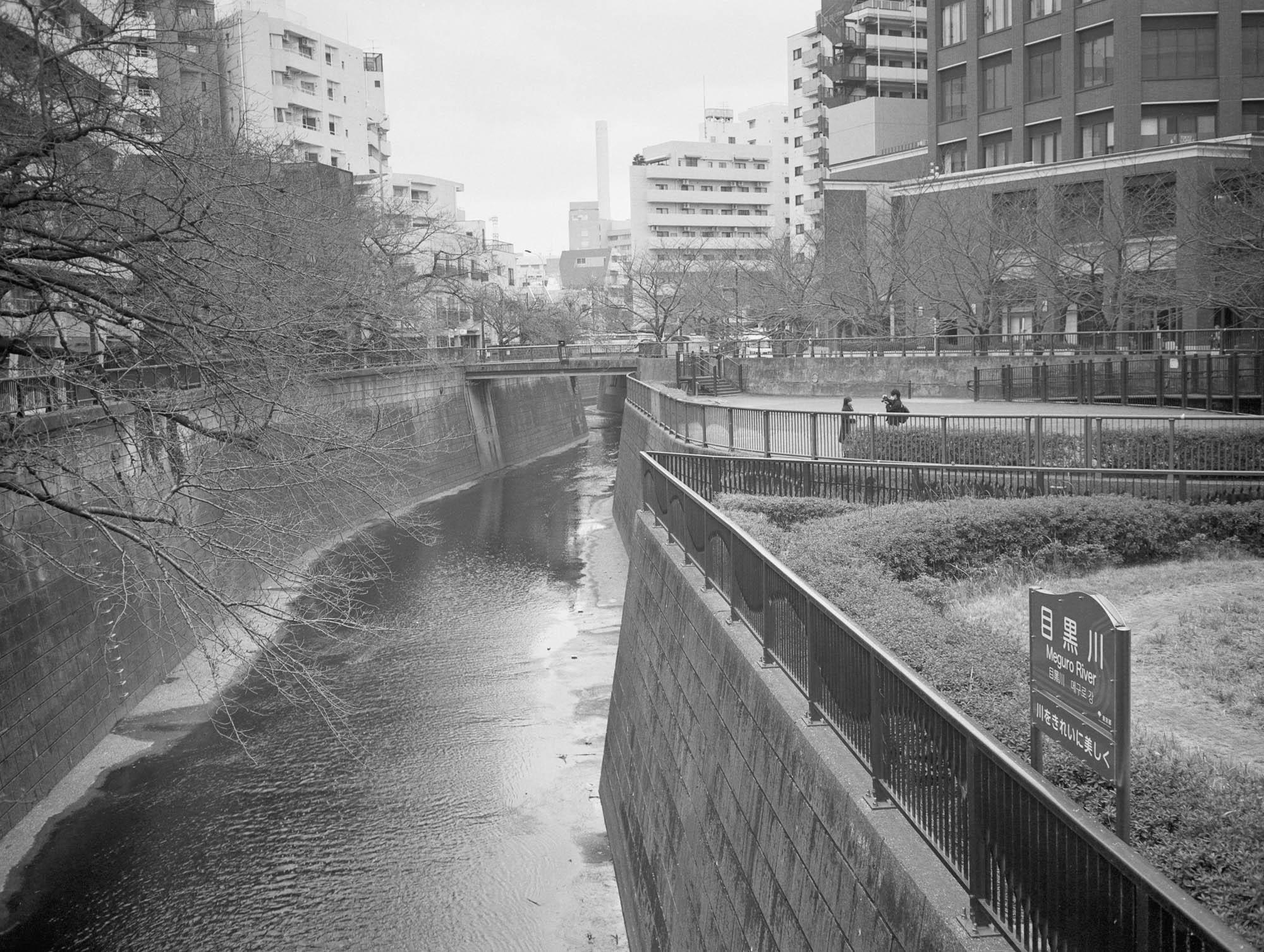
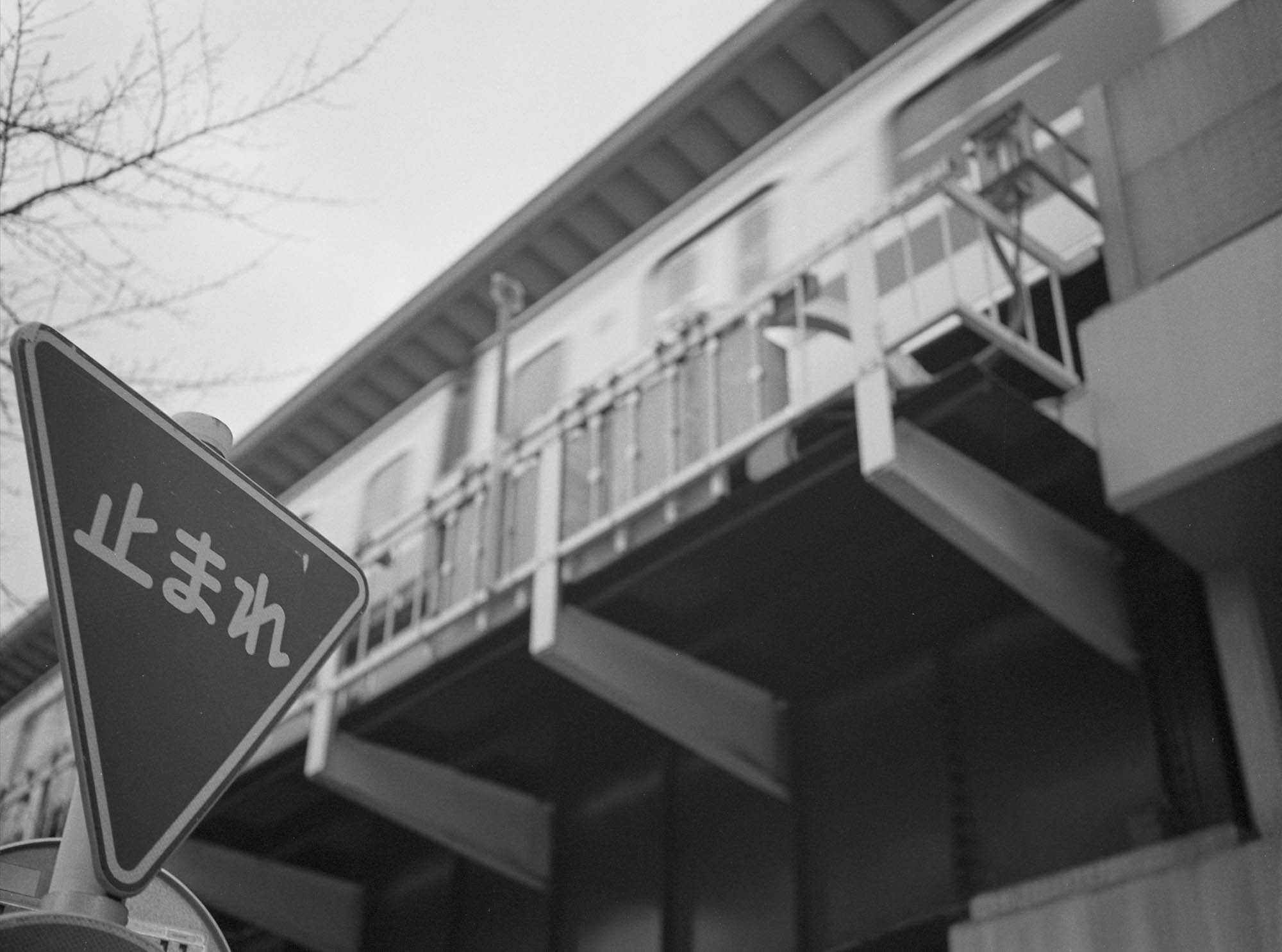
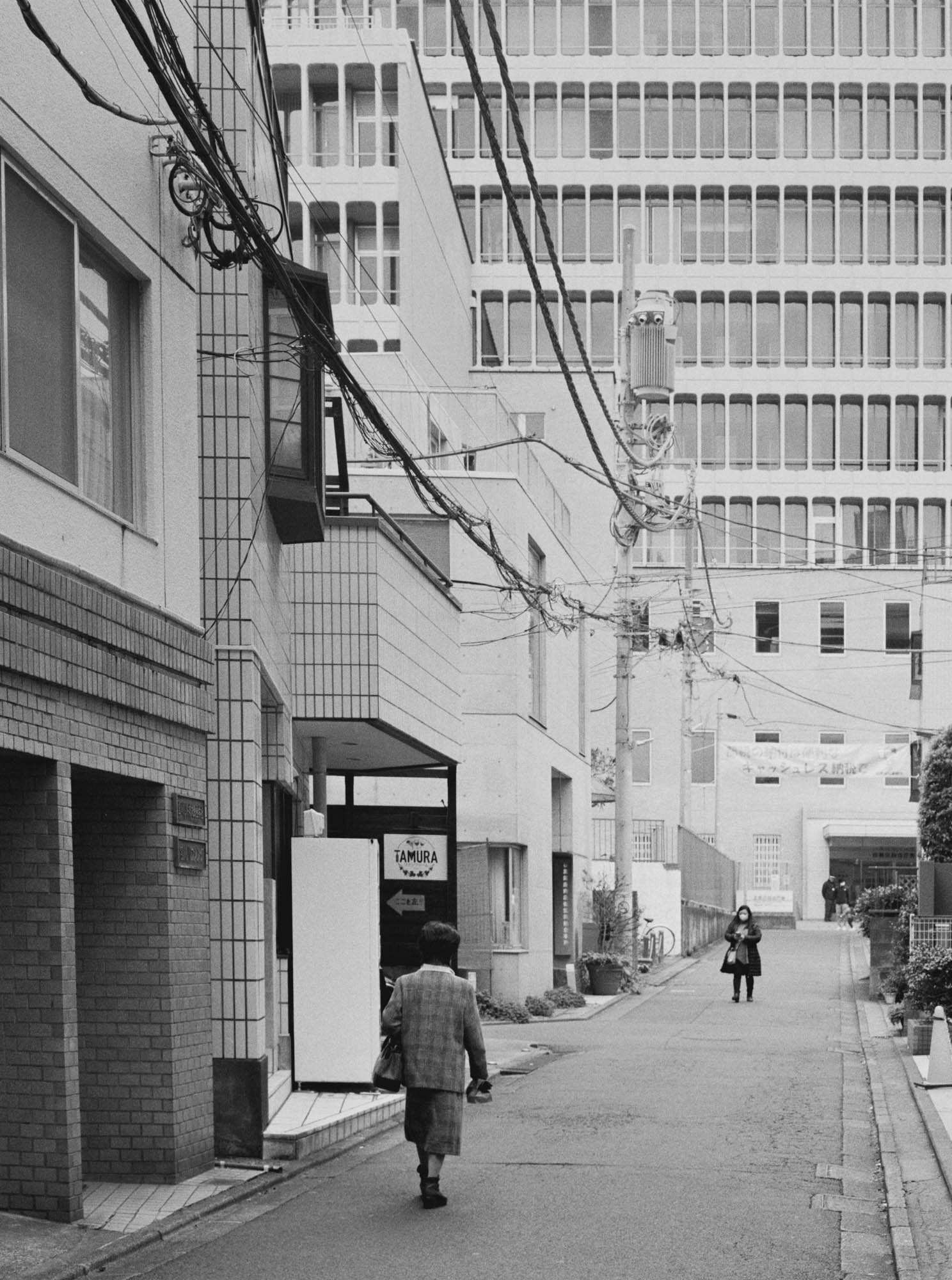
For the first roll, I shot Ilford Pan F Plus 50, which is a wonderful sharp film but in the dark wintry streets of Nakameguro perhaps was not the best idea.
You can probably tell that it has a sharp lens. With ten elements in ten groups, it has quite a complex design but with two limitations. Firstly, it’s has a measly 1.6x zoom range of 55-90mm. That makes it equivalent to 34-56mm in 35mm terms or ‘not very wide to not very long’ in human vernacular, and it moves in four steps rather than allowing you to zoom seamlessly.
Secondly, it struggles with a slow maximum aperture of F/4.5-6.9 through the zoom range. So Ilford Pan F 50 is probably not the best choice. Ultimately, it’s a point and shoot with all of the trade-offs that come with it.
It takes a while to start up and is not particularly responsive. It certainly gives you more control than a regular point and shoot, though, having two aperture priority modes, with the AS maintaining normal metered exposure so you can use flash for fill light rather than as a replacement for light. You can also shoot manual with it, though that’s an awkward process and I tend not to. Most of the time I leave it on Program mode, which is basically automatic but with the advantage of still requiring you to manually pop-up the flash. That works for me because of my biggest frustrations of most 35mm point-and-shoots is their tendency to default to autoflash when you turn them on.
It has autofocus too, obviously, and for the most part it works well. Again, it’s just like a regular point-and-shoot, where you focus on the centre of the frame with a half press and then recompose before releasing the shutter. It’s not fool proof, at least not for a fool like me. It misses focus occasionally. It does have one great feature, though, in that it let’s you know the general distance in the viewfinder before you take the shot. That gives you the chance to check beforehand and the fact that I find myself looking at it most of the time is probably a good indication that you need to be careful. It is still a step up from a regular point and shoot where you never know how it’s going to come out. It can also manually focus, which is kind of pointless here, since there’s no feedback to tell you whether you’re subject is sharp or not. You have to guess the distance and it’s so slow as not be not worth it most of the time. The only time I really see myself using this is if I want to shoot a set distance and I can’t move the camera because it’s on a tripod, or if I have to focus on infinity through glass and am worried about reflections tricking the focus.
So it is an awkward creature in many respects. Both frustratingly automatic and irritatingly quirky. Being a viewfinder camera, I have shot more than a few frames with the lens cap on. It actually does have a lens cap sensor that you can turn on that I didn’t even know that until I started to digging through the manual for the camera specs for this video. You have to push up the zoom lever and turn the camera mode dial to the ISO setting. Not very intuitive. You can also turn the beep on by using the ISO setting with self timer but I just leave it off . And I promise you, I’ll completely forget how to change these settings after having published this.
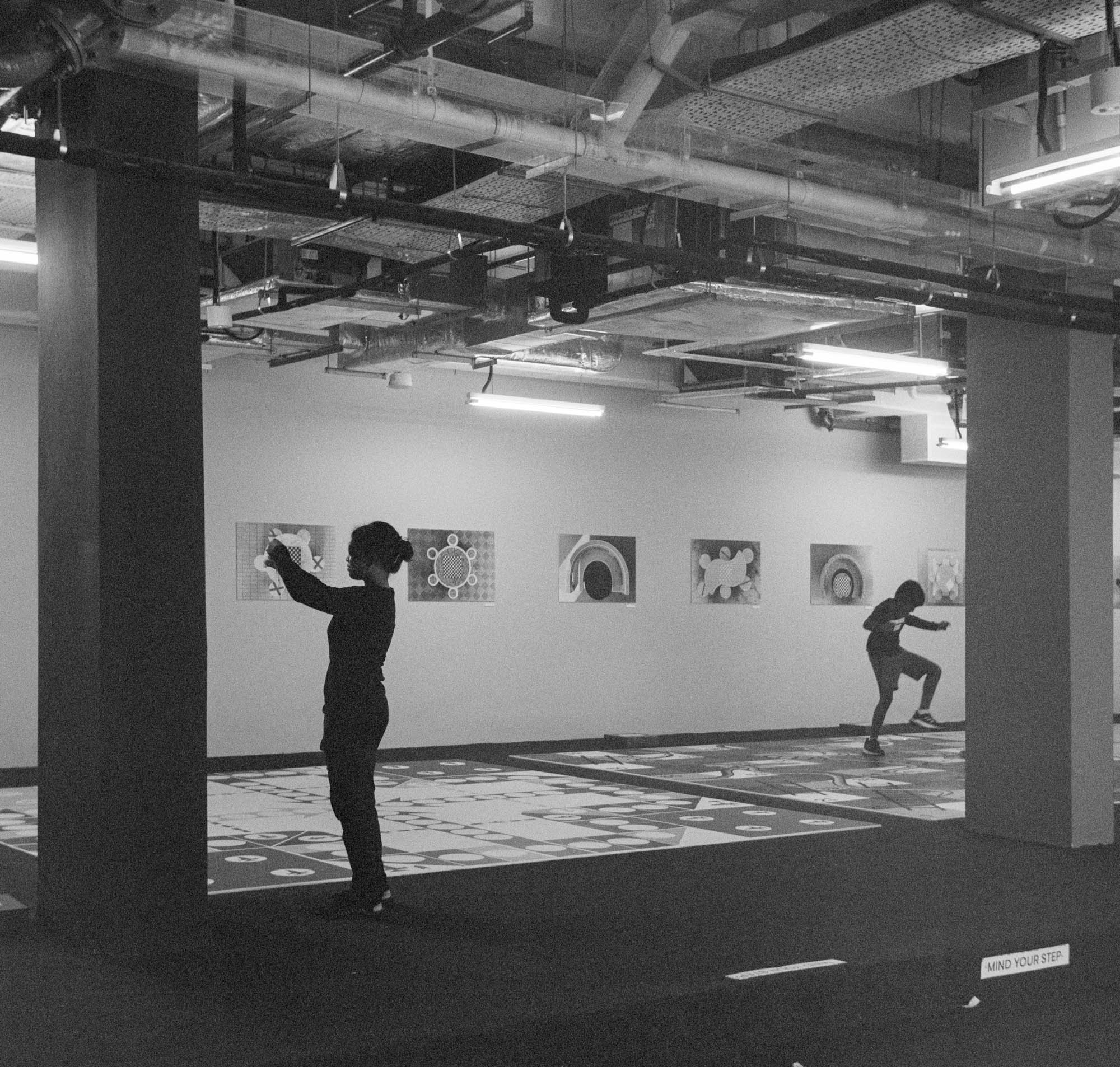
Another quirky feature of this camera is the vertical viewfinder. Being 6×4.5, it’s pretty much a half frame camera, fitting two portrait images in a 6×9 frame. The best thing about this design, honestly, is the grip and the shutter button. The camera feels good in your hand, despite its size and I found my finger naturally fell on the button, even if I had to rotate it to do a normal landscape photo.
And you can use this camera quite well one-handed but it is fiddly. I did drop this in the centre of Shibuya several years ago but that was more because I was relying on a generic wrist strap purchased on ebay that broke on me than a problem with the grip. It survived well but learn from my mistakes here, kids, do not attach a flimsy Aliexpress wrist strap to your Leica M11.
So Harvey is something of a clumsy leviathan of a point and shoot and that’s not something you typically want with you when you’re out on the street. In dim light with slow film you’re battling with the exposure triangle, particularly at the modest 55mm equivalent long end with its f/6.9 maximum aperture.
But what if we change film and actually give it a fighting chance? Can I do proper street photography with it?
Roll Two
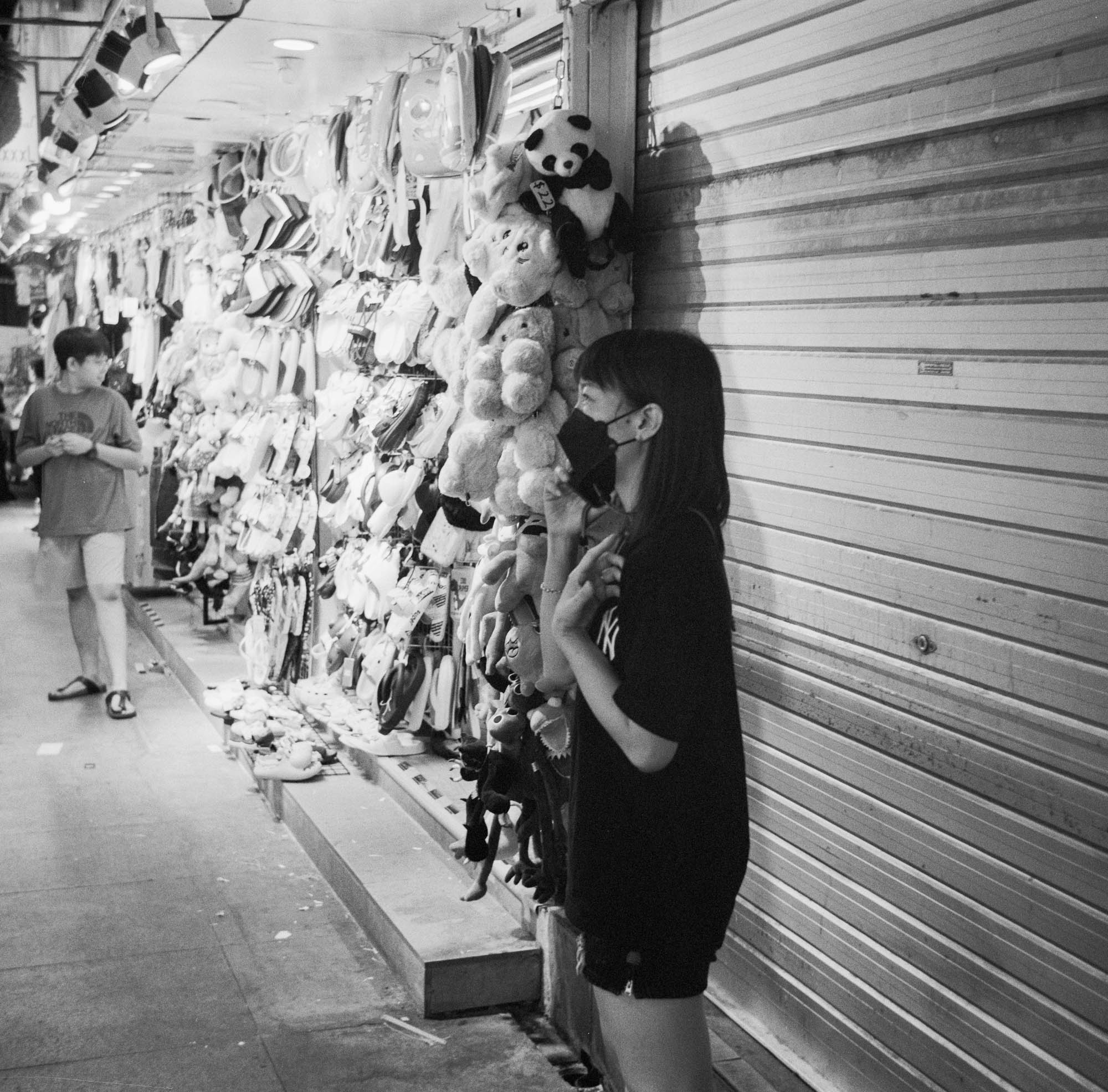
The second roll was more successful and no prizes for guessing that HP5 at 1600 is my preferred combination for this kind of photography. Being medium format, even when pushed two stops, the grain is small and refined and black and white streets lend themselves to a bit of grit anyway.
There are those that would argue that 6×4.5 isn’t true medium format. But a 6×4.5 is still 2.6 times the frame size of 35mm so that’s more than two and a half times the megapixels in today’s currency.
You still have room to crop but I find I’m less likely to do that than with my square frame medium format cameras. Here you have a 4×3 ratio that is exactly the same as my micro four thirds camera, and much more flexible than a square format. If you crop a 6×6 frame for horizontal or portrait orientation you lose the benefits of the larger real estate anyway. You could certainly go bigger but if you were 6×9 you’d need a bigger camera with a bigger lens and you would only get 8 frames. I do have a 6×9 camera but don’t use it as often just because of cost of consumables. Film has gone up in price and while we all have to make sacrifices to fund our hobbies my wife told me that apparently my kids still need at least one functioning kidney each to survive.
So this can be more economical on film but you do miss out on a little bit on that medium format ‘look’, where even with a moderate aperture and focal length you can throw out the background to get that soft blur and 3d pop. The out-of-focus areas are actually quite dreamy with this lens but with all of the compromises of the smaller frame and slow lens, combined with the focusing distance of 1m, you are limited to shooting people no closer than waist high, which doesn’t often make for a dramatic portrait, even though it could be a great tool for corporate head shots.
But if you want a studio camera, get a Hasselblad or Mamiya RZ. This a point and shoot. A point and shoot with one huge difference. It’s sharp. The lens resolves detail with surgical precision that can beat any 35mm camera and lens combination. With this in your hand, you’re really carrying with an analogue powerhouse.
Roll Three
I was not done yet. I had one final roll of film to go. Now for some Tokyo night photography, this time using Kodak Portra 800 Colour Negative film.
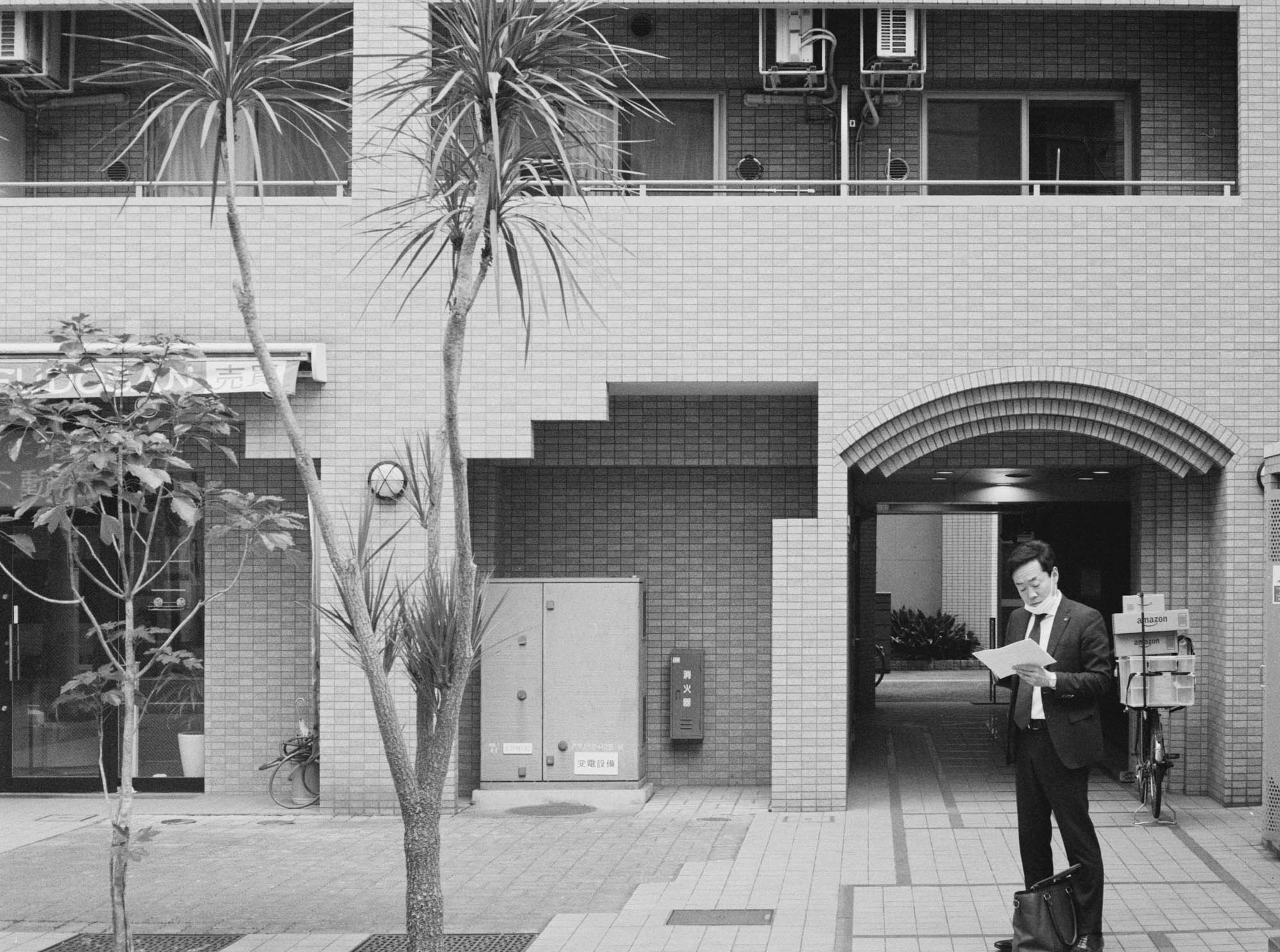
I was surprised how well I was able to shoot at night. I love 800 speed colour film, though most of the time, its cost puts me off using it. Perhaps it would not have fared so well in the darker corners of Tokyo but in the bright lights of Shinjuku, I was still able to do hand-held street photography quite comfortably.
Recommendations
As I said, at the beginning, I am ambivalent about this camera. I find the shooting experience to be the same as shooting with a regular point-and-shoot. The small viewfinder, slow response, lack of feedback and overall plasticky feel of the camera body gives me a sense of remoteness from the experience and to use a well worn cliché using it doesn’t ‘spark joy’ the way some of my other old cameras do.
And yet, I find myself using it more than any other medium format camera I own. While not exactly pocketable, it is compact, convenient, and once you get to know its quirks, using it as an auto-everything photo maker can be quite liberating. This has been with me around the world since I first got it in 2015 and I’ve taken some great shots with it. The good thing about it being so ugly is I never feel that I’m going to get mugged while I carry it through some of the sketchier parts of town. Straight after the safe streets of Tokyo, I took it through the chaos of the Pettah region of Colombo and it drew only the occasional glance of confusion or mild disdain. And I’m used to that.
That doesn’t mean I’m relaxed about Harvey, though. Everything’s electronic and I suspect I’m living on borrowed time. Like a lot of automatic zoom cameras of the era, many of the parts are fragile and there are lots of stories about ribbon circuits in particular flexing and breaking after long-term use. That will kill the zoom mechanism eventually and one of the known problems with this is the cable that connects through the back of the camera to the LCD makes it difficult to read the frame counter when it wears out.
The fact that there you can buy new generic replacement ribbon cable parts for this camera is probably the best indication that it’s a ticking time bomb. Even if you can source the parts, though you will have a hard time getting it fixed. I bought this camera for AU$650 eight years ago but now the price has jumped up so much that I’d hesitate to replace it if it broke.
Would I recommend it to others? In some situations, yes, and in others no. As I wrote, I’m ambivalent. And you know the old joke about ambivalence. What’s the difference between ignorance, apathy, and ambivalence? I don’t know and I don’t care one way or the other.
That’s not true about this camera. Whether I’d suggest this camera to others, is not a straight yes or no. This is a camera that has some limitations and requires you to get to know it to use it properly. But once you do you can be stunned by the results and it inspires anything other than apathy. Just carrying it labels you as a 90s icon, it’s champagne accents perfectly complementing the frosted tips of your bleached blond hair as you cut a swathe through the crowd at that Fresh Prince concert to capture those classic hip hop poses on celluloid.
I know that I for one can’t help but get a little bit jiggy with it when I try to squeeze it into the pockets of my cargo pants while I’m out on the streets of Tokyo.




























































 Mark McMahon