Who doesn’t love unboxing videos, right? Well, in my latest video, I attempted to build up some suspense as I clumsily opened what wasn’t exactly a box. Instead, I revealed the Canon Prima 5, a forgotten point-and-shoot from 1991, known by various names like the Canon Sure Shot Max and the Autoboy Mini.
I snagged this camera second-hand for just AU$15, a real steal considering its potential. But the big question remained: does it work, and can I create art with it? Well, let’s dive into my initial impressions.
First up, some specifications, because nothing is more exciting than reading a list of bullet points about the features of an old point and shoot camera:
Lens: 38mm, f/3.5 with 3-point smart autofocus.
Auto-exposure with shutter speeds of 1/8-1/250s.
Integral flash. (Guide No: 9m at ISO 100.)
ISO range: 25 – 3200 (via DX code – 25 Non-DX)
Auto-load, wind and rewind of DX-coded film.
Dimensions: 125x68x43mm.
Weight: 245g (with battery)
Power: One 3V CR123A lithium battery.
A version with an autodate function was available.
Nothing particularly exciting, let’s face it, but it it does shoot up to ISO3200 for DX Coded film and while the f/3.5 lens is quite modest, it’s better than most zooms and unlike zooms, you know with a prime that the quality will be tuned to that 38mm focal length. To really test this camera, I need to run a roll of film through it. Colour film is like gold dust these days, and the prices are soaring. Yet, armed with Kodak Colorplus 200, I was ready to test this camera’s capabilities.
Now, onto the shots. From capturing leaves backlit by sunlight to exploring human interactions in a park, I attempted to weave narratives through my photographs. Whether it’s a solitary figure masked by foliage or a couple on a bench, each image tells a story, prompting viewers to ponder human existence and relationships.
Moving from nature to urban landscapes, I sought to celebrate human resilience and the quest for enlightenment amidst the complexities of city life. Through frames within frames and minimalist compositions, I aimed to provoke thought and reflection.
Yes, you can make art with it. Or at the very least you can reflect on your artistic intent as you intersperse random snaps with pretentious musing.
Despite its simplicity, the Canon Prima 5 impressed me with its sharpness and reliability. Sure, it has its quirks like occasional flares and a default autoflash setting, but its performance outweighs these minor drawbacks.
Now, the big question: is this camera a hidden gem or just another addition to the plastic pile? I’m leaning towards the former, but I’m eager to hear your thoughts. Do you have any recommendations for budget compact film cameras? Let me know in the comments below.
As for me, I’ll continue experimenting with this camera while keeping an eye out for other photographic relics. Who knows what hidden treasures I might uncover next?
Ah, the allure of the Leica M6, a camera to flaunt wealth and artistic prowess alike. But why bother with ostentation when you can blend in with the proletariat using a humble companion like the Nikon N55? Sure, you won’t garner as many admiring glances, but the stares you do receive may be tinged with curiosity or bemusement, which, let’s face it, is attention nonetheless.
Let me regale you with the tale of my photographic escapades through the bustling streets of Shanghai, armed not with a Leica but with the unassuming Nikon N55 and a curious film stock mysteriously labeled as 800T, procured from the upscale online emporium that is Ali Express. With this unassuming combination in hand, I embarked on a journey to capture the essence of the city.
As I peered through the viewfinder of the N55, a sense of anticipation mingled with uncertainty. Something seemed amiss – the exposure appeared off-kilter, suggesting a potential mismatch between the film speed and the camera’s settings. Despite this initial hiccup, I resolved to soldier on, embracing the idiosyncrasies of the N55, which stubbornly refused to recognize DX codes, leaving me with no option but to compensate for the overexposure manually.
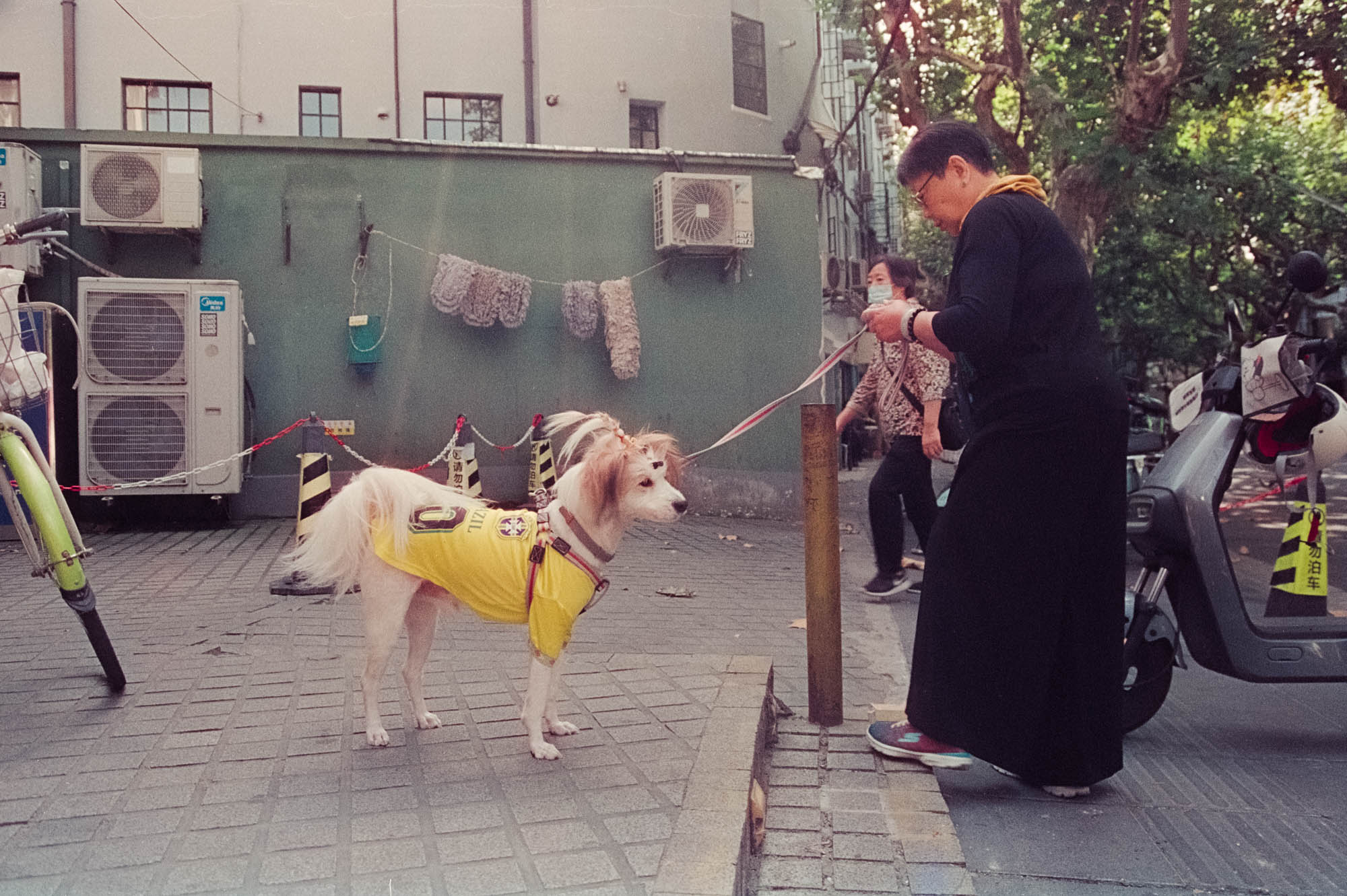
Undeterred by technical hiccups, I ventured forth into the labyrinthine streets of Shanghai’s historic neighborhoods, where brighter conditions finally afforded me the opportunity for more favorable shooting conditions. The results, while not without their flaws, offered glimpses of everyday life in this vibrant city – from the hustle and bustle of the marketplace to the quiet serenity of a secluded alleyway.
Now, let’s delve into the enigma that was the 800T film. Despite my initial reservations about its origins and processing, it performed admirably, even when subjected to a two-stop overexposure. A cautious approach to development paid dividends, yielding clean, balanced negatives that belied the film’s budget-friendly origins.
Yet, amidst the mundane scenes captured on film, a few moments stood out like diamonds in the rough – a fleeting glimpse of Chinese line dancing in a sunlit square, the mesmerizing interplay of light and shadow on the city’s architectural facades, and the endearing charm of canine companions frolicking in a local park. These ephemeral encounters served as poignant reminders of the richness of life, transcending mere visual aesthetics.
The Nikon N55 and 28-80mm f/3.3-5.6G
But what of the N55 itself? Despite its plastic construction and finicky autofocus, it proved to be a stalwart travel companion, compact enough to slip into carry-on luggage yet robust enough to withstand the rigors of urban exploration. Its quirks and limitations only added to its charm, serving as a testament to the resilience of analog photography in an increasingly digital age.
A new roll of film, this time some Kodak Colorplus 200 and while it didn’t give me those same classic Cinestill halations or cinematic tones, it was more than able to capture the veracity of the streets with its muted palate.
And let us not overlook the unsung hero of this photographic odyssey – the 28-80mm kit lens. Despite its modest specifications, it delivered surprisingly sharp and contrasty images, a testament to the craftsmanship of its optics. In the hands of a skilled photographer, it transformed mundane scenes into captivating vignettes, elevating the humble N55 to new heights of artistic expression.
Great for Travel
In the end, the Nikon N55 may not have the cachet of a Leica or the technical prowess of a modern DSLR, but it more than held its own in capturing the essence of Shanghai’s bustling streets. It’s small and light so it won’t break your back on a long day of shooting. It’s cheap and even cheaper looking so no-one is going to mug you for it. Its kit lens is surprisingly sharp and it’s quick, smooth, and responsive. So, if you find yourself in need of a reliable travel companion, look no further than this unassuming gem of a camera – the Nikon N55.
Welcome to he Pentax 120SW – a tiny do-everything-for-you point-and-shoot from right at the time where everyone started buying digital cameras. To test this camera out, I decided to explore the Gardens by the Bay area of Singapore to see if I could experience the wonder of nature.
The Wonder of Nature
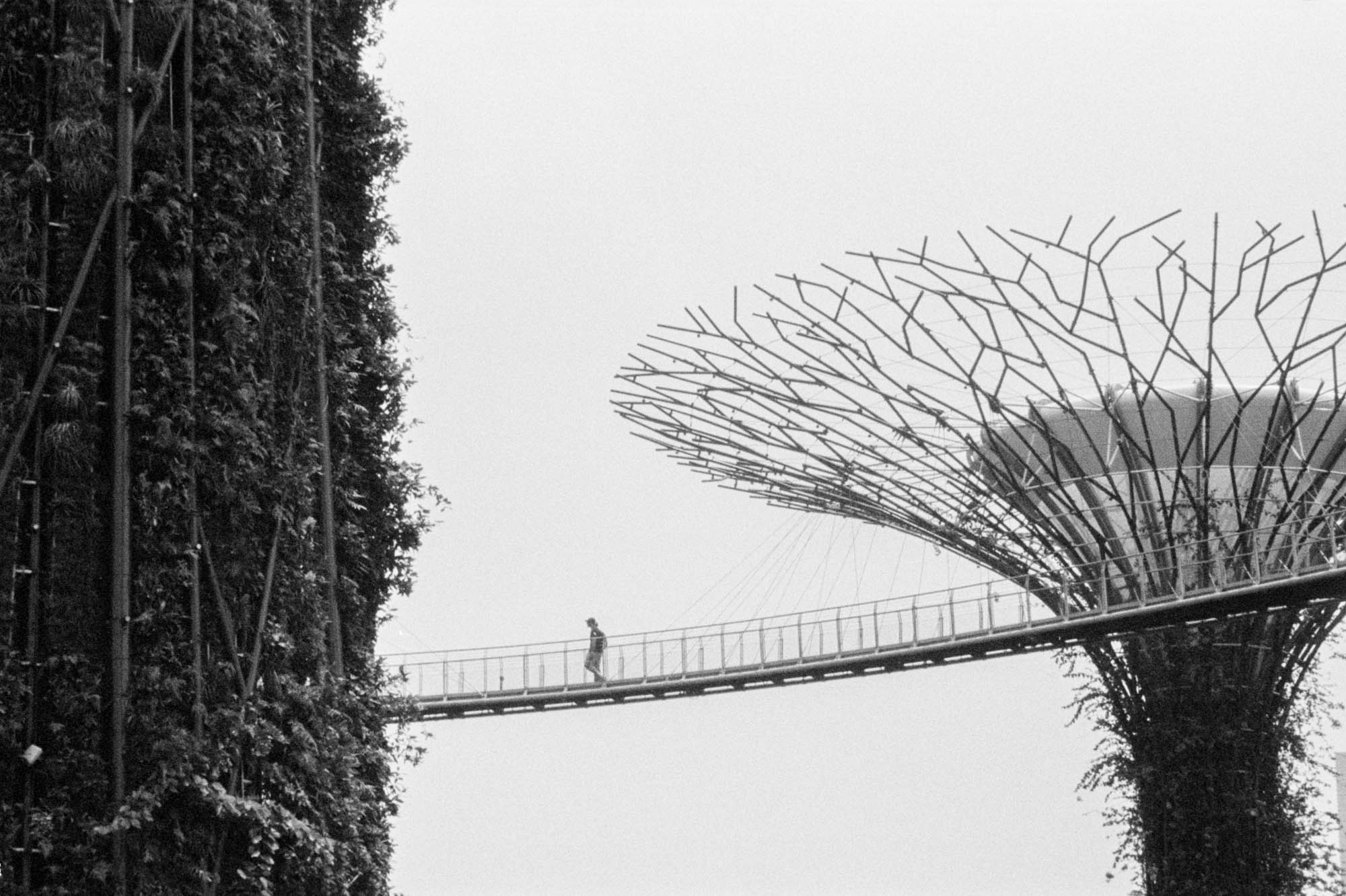
I think you can probably guess that the byline of the above video is somewhat sarcastic. Gardens by the Bay is as natural as a terra-formed Mars colony, with microclimate pods nestled among metal trees, all in the shadow of Marina Bay Sands hotel.
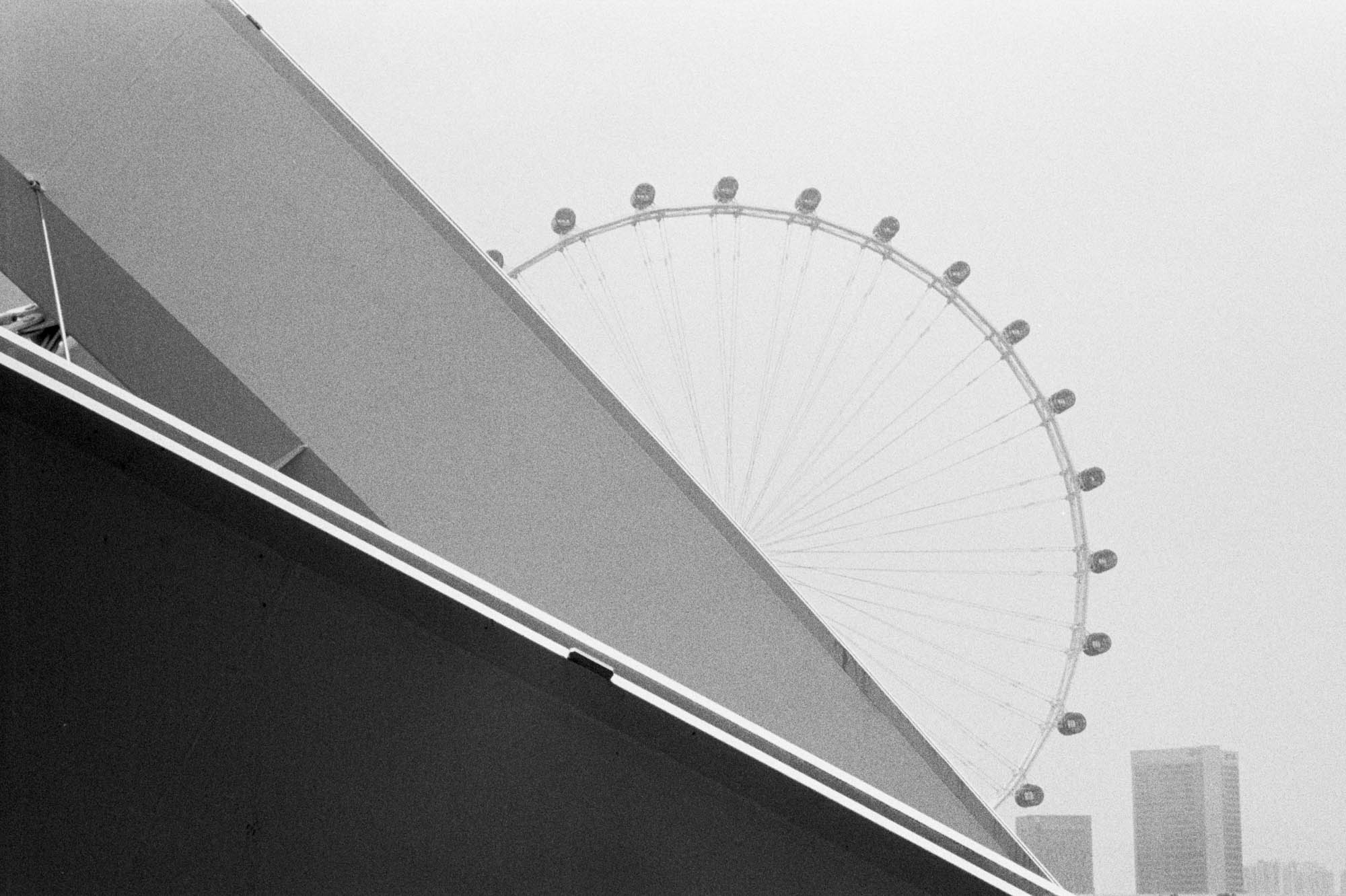
Most of the nature exploration involved photographing the topography and the tourists that milled around the area – wildlife of sorts, I suppose, just not the normal fodder for a David Attenborough documentary.
Using a mix of Ilford HP5 and Kodak Colorplus 200, I nevertheless put on my virtual pith helmet, strapped on my scythe and cut a swathe through the metal and concrete forests of Gardens by the Bay.
About the Pentax Espio 120SW
Well what’s to say? It’s a point and shoot.
It has a 28-120mm F5.6-12.8 lens, 6 elements in 5 groups, autofocus with focus lock, and with a minimum focus of 0.5m. It’s shutter speeds are from 2-1/360s and it has a bulb mode that’s 1/2s-1min though if it came with a remote shutter, I don’t have one so I’m not sure how useful bulb really is.
Like many point-and-shoots, this one is small and it’s light. It weighs 190 gr. without battery.
Pentax Espio 120SW
That, and it’s sweet sexy looks ,are probably it’s main attractions. Apparently, other than the film door it has an aluminium body. I don’t know though. It tastes like plastic to me. I don’t know how much this cost either but it was definitely positioned at the ‘luxury’ end of Pentax’s plastic point and shoot lineup.
in 2001 it won the Technical Image Press Association’s compact camera of the year award. But given those times, it’s probably like winning ‘Best new DSLR’ in 2023 when the whole world has gone mirrorless. You do get a really pretty orange backlight on the LCD though.
One of the problems is that it’s a Pentax. This was a company that churned out compact camera models like barbecue sausages and it’s not like there was ever much cachet in owning one. I have several Pentax point-and-shoots in my cupboard. I also have a few broken ones now hidden in draws that I might sell on ebay some time labelled ‘top mint’ but with ‘please read’ asterisked and in small print.
The fact is that there were so many camera versions, some good, some bad. How do you know if you’ve got a decent one?
Well you may have already made up your mind on this one but I think to make an accurate judgement, it’s only fair that I use some of that money I’ve been saving up for my kids education and blow it on a roll of colour film. Seriously, the things I do for science. And nature … obviously. Now this was Kodak Ultramax. Still a fast film at ISO400 but still a challenge for such a small aperture zoom on a cloudy day. BUT if Livingstone could conquer Everest with nothing but a woolly bobble hat and a block of Kendal mint cake then I could take on the challenge of Marina Bay with my trusty Pentax. Actually I might have got some of that detail wrong but that’s what happens when you trust Chat GPT to write your reviews for you.
A Slow-Lensed Camera
The Pentax Espio 120SW is perhaps not the best camera out there in terms of specifications and it doesn’t have a full array of modes and features. There’s no portrait, sport mode or dedicated macro facility here. You really have very little control.
You do get 25-3200 ISO, automatic DX coding, self-timer, automatic film advance, infinity and spot AF modes.
And for what it is, it’s capable of producing great results. It can meet the resolution of film and my favourite photos show that this has a lens that can be both sharp and contrasty. I didn’t really see much flare either thanks to it’s ‘super multi coating’.
If you use it properly it delivers good results. Unfortunately I bet back in the day there are a lot of people who have used this camera and wondered why the images came out blurry. That probably comes down to the lens. It has a maximum aperture of f/5.6 at 28mm down to f/12.8 at 120mm. That makes it tighter than the proverbial cat’s anus, though I haven’t actually done that test myself and I don’t know any proverbial feline proctologists.
You only get a focus confirmation or a warning light to tell you to use flash in the viewfinder and that’s not much feedback. It’s definitely capable at 120mm as shown here but where my shots failed it was usually because I was being overly optimistic of my ability to hand hold. Even with 400ISO, a dull day in Singapore meant that telephoto and slow shutter speeds conspired to give me soft results. Don’t bother putting 100 speed film in this unless you’re prepared to shoot with the flash turned on.
But it’s Sharp
On a sunny day like we have here in Australia I still managed to get great results. Finishing the colour roll, I was able to get really vivid photos like this.
Admittedly, I might have underdeveloped a bit, which often gives colours, contrast and grain a bit of a boost but if you look here, you can see that it produces pleasing images.
As with any example of this kind of camera, though, you have to accept a certain randomness in the results it produces. There was no way I could tell the camera where to focus in this photo and while having the ability to at least spot focus fix on infinity focus is nice, the end results can be a bit unpredictable depending on the film or quality of light. I wasn’t really able to get it to produce any bokeh but that’s hardly surprising. I could get some subject separation if I shot close up and what I did see in the out of focus areas wasn’t ugly. It just wasn’t particularly distinctive.
So what’s your experience with cameras like this? Have you owned this particular model and what do you think of it? Some point and shoots can be ridiculously overpriced these days. I’m looking at you Olympus Mju II.
If you’re prepared to slum it at the ugly end of the Pentax range, though, you might find a bargain. There are definitely hidden gems out there if you are prepared to be patient.
But let me know your thoughts. From my perspective, if not the best tool for the job, this camera isn’t the worst. And like your phone it’ll give you a photographic experience that you can put in your pocket; just with this one, it’s actual film.
My advice, though, use a FAST film so you can make the most of the sharpness of the lens stopped down and give you a bit ore leeway with hand holding. Or use flash, which on these things is… ‘a look’ and who knows? Maybe one I’ll experiment with a bit more on a future review.
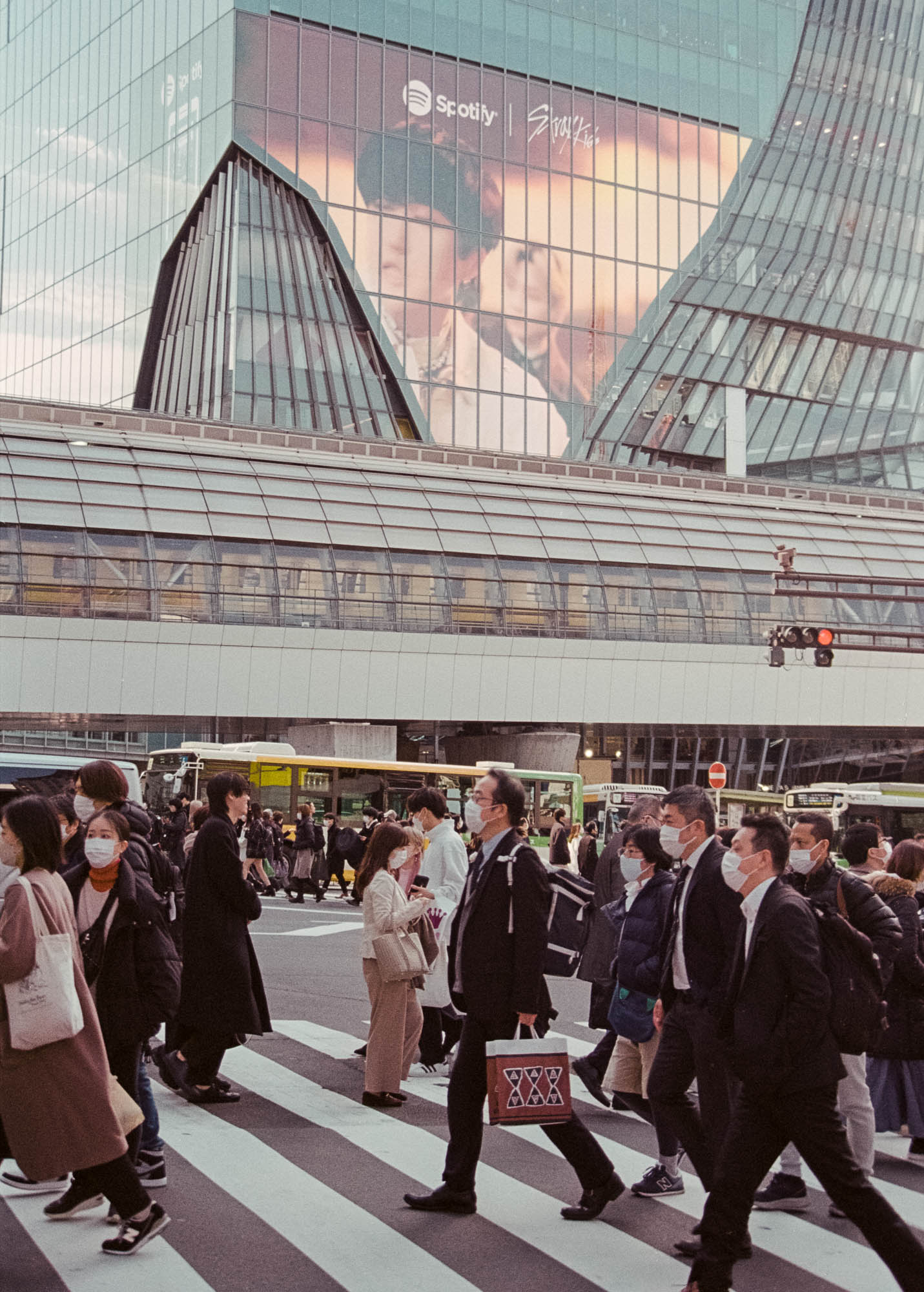
It was late February (not the 30th) and I was in Tokyo and wanted to go out and take some street photos on film. The classic choice of lens for this kind of photography would be something small and moderately wide. Maybe jump on the Diane Ar Bus with a 35mm or the get my Cartier Bress on with a slightly narrower 50mm.
But I didn’t do that. Instead I picked a monstrous old manual metal and glass 35-200mm zoom lens. Today we’re going to explore why.
A Marvelous Lens…
Was it the logical choice for the street? Probably not. But why do I find myself using this more than just about any other manual focus lens I own? It’s an optical marvel.
Before you spit vehemently on the floor at the description of a manual superzoom lens as a marvel, you have to cast your mind back to those bleak days of the early 80s when the optical imaging world was disrupted by the introduction of zoom lenses. It was a tumultuous time for lens manufacturing. Autofocus was starting to get its clumsy foot in the door and zooms were becoming more commonplace. After all, who doesn’t want a lens that gives you great versatility and ease of use?
In 1982 the longest zoom that Nikon could offer was a 50-135mm f/3.5. In the subsequent years, this range extended to 35-105 and 35-135mm. So you could see how they were incrementally improving things over time.
This particular lens was released in 1985 after what was by all accounts a long and tortuous process to design and refine it to achieve its 5.7x zoom range. That was the same year that Nikon released its first retail autofocus SLR the Nikon F-501. While the Nikon L35AF in 1983 had shown the potential of autofocus in compact cameras, it wasn’t mainstream at that point and the 501 was released at the same time as the manual focus F-301 which was probably more popular.
No autofocus but a very large zoom range. And In that context, when this lens was released, it was probably already a little out of date, while still being overly ambitious at the same time.
… But a Compromise
The result is a compromise but isn’t everything in life a compromise? You’re always going to struggle fitting your baby bassinet in your Bugatti Veron and if you’ve ever actually owned a pocketknife you’ll understand the limits of your corkscrew and scissors. Of course, that tool for getting the stones out of horse’s hooves is 100% fit for purpose even if that’s a purpose you’ll never need.
While the zoom range is great, it doesn’t go wider than 35mm.
The maximum aperture is 3.5 at the wide end and it’s variable to 4.5 at the long end. So not the worst but it’s not very fast.
It CAN focus as close as 0.27m or 0.86ft, giving a decent if not quite macro 1:4 life size reproduction. Annoyingly, that’s only at the 35mm end, accessible by a ring that increases the distance from the focal plane. Effectively a built in extension tube. It would be nice to have had it at the longer end to give you more working distance.
It does have amazing build quality. Really amazing. You could bludgeon your baby with it and given you might need to, to actually squeeze him into your Bugatti, that’s a selling point in itself. In any case, if you dropped it on your toes you’d be much more worried about your toes than the lens.
It weighs 740g or 1.63lbs for you imperials and that’s heavy but it is surprisingly compact. It has a 62mm filter thread which is actually quite small and probably smaller than most modern superzooms.
Compare it to Nikon’s modern 24-200mm Z lens and it still holds its own when you think that it’s nearly 40 years later. Well ok, it might teeter a bit.
While it is reasonably balances on my Nikon FE it’s not exactly discreet. The push-pull zoom itself is a compromise. I do have a couple of these style lenses and once you’ve had practice, it’s actually possible to zoom and focus in one action but this lens is bigger and much stiffer and more clumsy.
But it is what it is and I guess that’s going to be the theme of this review. But if it is what it is, then what is it? With all these compromises, is it good enough? To find out, I took the camera on a walk from Harajuku to Shibuya on a cold February day in Tokyo
From Harajuku…
It Is What It Is
Is this the swiss army knife of lenses or am I expecting too much? You can’t open a bottle of wine with it OR get the stones out of horses’ hooves. But can you take good pictures?
Earlier, I called this an optical marvel. There is a lot of lens crammed in here. Realistically, the marvel is that they managed to create it and it not be totally horrible. With 17 elements in 13 groups all working together to minimise aberration and field curvature at the various zoom lengths, it should have the light transmission qualities of a lump of coal.
But somehow light manages to reach the film plane and while this isn’t a 50mm f/1.2 Z lens, that lens can’t shoot 35 mm or 85mm or 135mm or 200mm. You get the idea.
It does distort but that’s very fixable and I have and no problems bending those lines back to right angles in post. F/3.5 is slow but you could see, on a winter’s day, it was still quite usable with 200 ISO Kodak Colorplus. The corners are soft wide open and diffraction creeps in by f/11 but at it’s rare that I’m going to want to shoot f/22 anyway.
I call it a Marvel and if there’s a downside to that, using it is the creative equivalent of watching a Marvel movie. You get a bit of comedy, romance, fantasy and action, and that’s even before I’ve taken the photo, just with trying to compose, zoom and focus with it is a drama. It’s not a shoot from the hip Arthouse experience though you could probably push a roll of HP5 in there if you want that black and white Zac Snyder aesthetic.
Perhaps my biggest complaint is that it is a bit like Captain Marvel. Overpowered but leaden and dull as a result, and I guess it ends up being a bit unsatisfying because it never quite lives up to its own ambition.
… to Shibuya
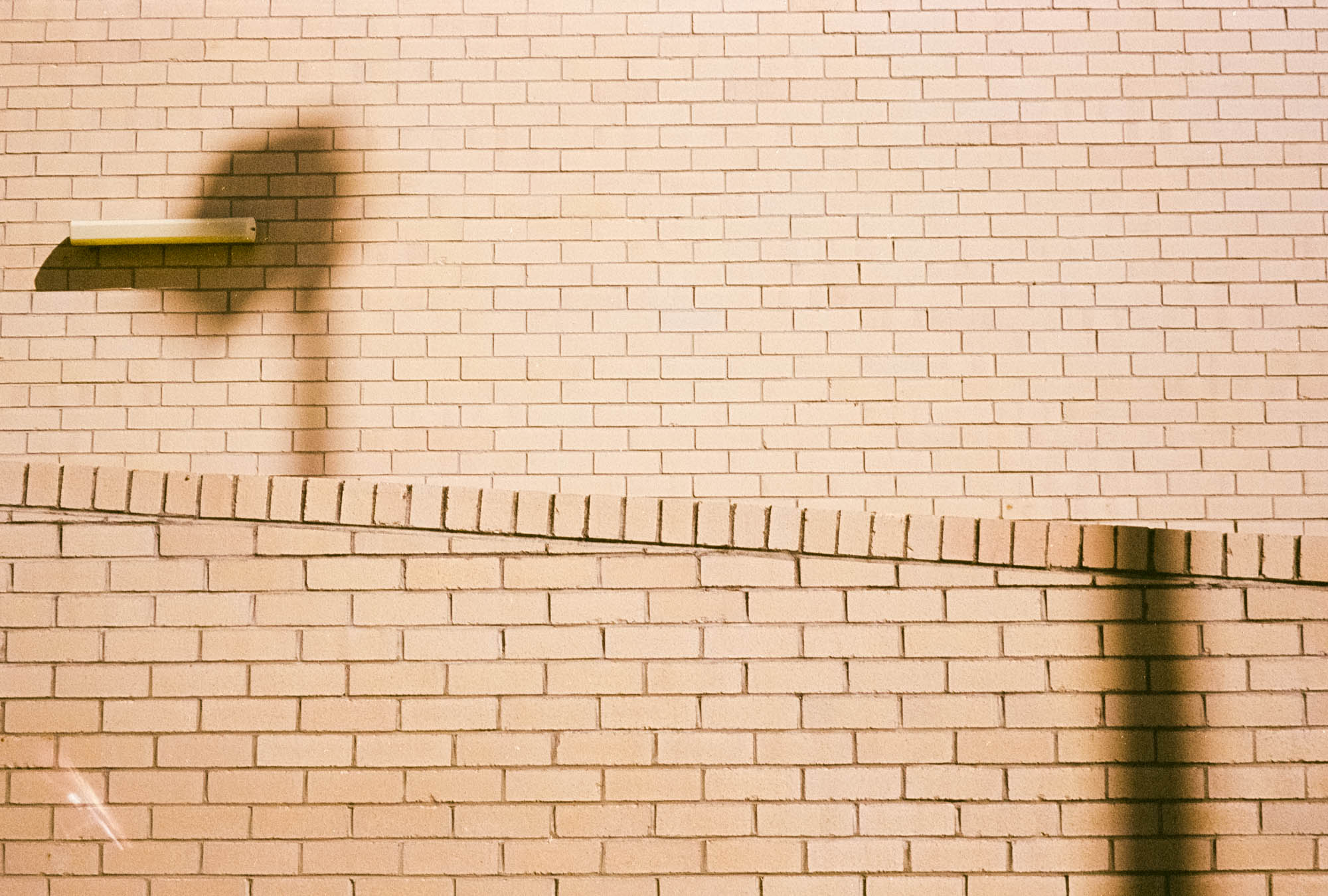
You can see that the best photos are the ones where I’ve had time to think through a composition to take in a street scene, capture close-up detail, or narrow the frame to point out details or find angles in the architecture. The strength of this lens is it’s versatility not it’s sharpness.
Great for the Price
In doing some research on this lens from people who actually know what they’re talking about, I found Nikon’s own review in which the words ‘relatively’ and ‘satisfactory’ both appear 6 times. That probably tells you something; and that’s coming from Nikon’s own PR machine.
It was never Nikon’s most successful lens but that might be because this hefty lens came with a hefty price-tag. As of 1996 this was still selling for US$1,290 and while it’s long discontinued now, that’s a testament to the engineering that went into it and the fact that there weren’t any great alternatives. As early as 1983 Tamron did have a 35-210mm lens available but from everything I’ve read, if that one’s a Marvel, it’s much more Carol Danvers than Nick Fury. For 15% of the original asking price you can now pick up an excellent quality copy and leave it on your camera. So why even bother to slum it in the 3rd party ghetto.
Ultimately, I’ve never heard anyone complain about the image quality. People don’t look at my photos and say, ‘oh, did you use a Nikon AI Zoom Nikkor 35-200mm f/3.5-4.5S’. They might say, ‘did you really take a photo of that.’ But that one’s on me, not the lens.
To me it’s sharp enough and when I look through my Lightroom catalogue it’s probably my most used lens. The reason for that may well be because I lack any sense of aesthetic intent as a photographer. I’m not getting up before sunrise to capture that perfect 20mm landscape, or using it exclusively for shallow depth of field portraits or sports photography.
This is the lens that I put on when I’m indecisive or feeling lazy. It’s a great travel lens and it’s also the one that I’ll stick on my camera when I’m just out walking the dog or don’t have any sense of what photographic opportunities might be out there. For me, that’s most of the time.
But let me know your thoughts. What’s your most versatile lens? Would you use a bloated beast like this or do you prefer to just take a wide prime locked to f/8 and zone focusing to capture the decisive moment?








































 Mark McMahon